I've Seen Strong Leaders Leave Stable Roles: Why High Performers Drift Before They Resign
Dr. Charles Castillo
Mental Resilience Counseling | THE P.H.O.E.N.I.X. MODEL™

A resignation letter from your strongest clinical leader lands differently than any other resignation letter. It's not just a staffing gap. It's a signal — and most organizations misread it.
The instinct is to treat it as a compensation problem. Offer more money for the counteroffer, benchmark the role against the market, assume the lateral opportunity simply paid better. Sometimes that's part of it. But in my experience, it's rarely the whole story, and treating it as the whole story means the same pattern repeats with the next high performer.
The real question underneath Why are our top-performing clinical leaders leaving for lateral positions? is usually a different one: what were we not seeing in the months before they decided to go?
What Leaders Often Misunderstand
When high-performing leaders leave for similar roles, they are rarely chasing a new title. They are often searching for sustainability.
Many still love the profession. They haven't lost their skill, their competence, or their commitment to the work itself. What they've lost is the belief that they can continue leading under the current conditions. They are not running from responsibility — they are running toward an environment where they can reconnect with purpose, stability, and hope.
That's an organizational signal, not simply an individual decision. And it's frequently misread as a compensation issue because compensation is the easiest variable to measure and the easiest one to act on quickly. Organizations often increase pay when the deeper issue is leadership fatigue, moral distress, and loss of meaning. Fair compensation attracts talent. Healthy leadership keeps talent. When people lose their future-focused anchor, no financial incentive alone can replace it.
Why This Problem Is Bigger Than It Looks
The World Health Organization defines burn-out as a syndrome resulting from chronic workplace stress that has not been successfully managed, characterized by energy depletion, increased mental distance or cynicism toward one's job, and reduced professional efficacy. That last piece matters most here: reduced professional efficacy doesn't always look like reduced performance. A leader can still be delivering strong results while quietly experiencing exactly this kind of depletion underneath.
Gallup's most recent workplace data found manager engagement falling sharply — from 27 percent to 22 percent between 2024 and 2025, one of the largest year-over-year drops on record. That's not a coincidence sitting alongside rising lateral attrition among strong leaders. It's the same underlying strain showing up in two different metrics.
A 2025 study on work-life balance and business management found a significant positive correlation between perceived work-life balance and employee motivation, and linked stronger work-life balance with reduced burnout, improved job satisfaction, and stronger loyalty. For clinical leaders specifically, a recent systematic review and meta-analysis on nurse burnout emphasized that burnout in healthcare is shaped by organizational and contextual factors, not only individual coping — reinforcing that this pattern is structural, not a personal failing on the leader's part.
Put together, this means a leader can be performing well, hitting every visible metric, and still be losing the internal capacity to sustain that performance. By the time the resignation letter arrives, that capacity has usually been eroding for a while.
What THE P.H.O.E.N.I.X. MODEL™ Sees Earlier
Leadership drift begins long before resignation. It starts when leaders become disconnected from the mission that once inspired them.
THE P.H.O.E.N.I.X. MODEL™ begins with Perceive, helping leaders — and the organizations around them — recognize that loss of connection early. Through Harmonize and Orient, leaders restore balance and reconnect with purpose. As they Endure, iNtegrate, Inspire, and eXcel, resilience becomes part of how they lead rather than something they depend on only during crisis.
The earliest signs are often subtle. Leaders become less engaged in mentoring, less curious, more reactive, and increasingly focused on simply getting through the day. Innovation declines. Decision fatigue increases. Conversations about the future become conversations about survival.
These are not signs of poor leadership. They are signs that resilience is being consumed faster than it is being restored. Organizations that recognize these patterns early have the opportunity to strengthen leadership before they lose it.
The Drift Most Retention Plans Miss
The graphic below shows the progression I see most often — and where most retention conversations start looking, versus where the actual story begins.
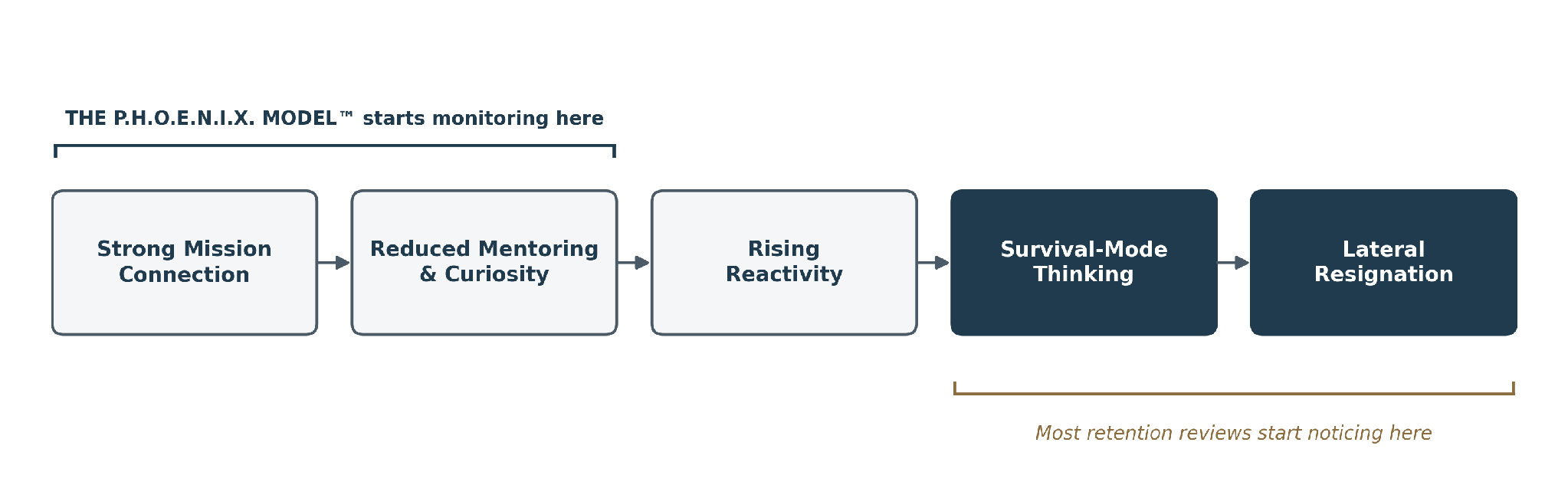
Figure 1. Most retention reviews start noticing a problem at "Survival-Mode Thinking" or the resignation itself. THE P.H.O.E.N.I.X. MODEL™ starts at the first signs of reduced mentoring and curiosity.
What Leaders Should Do First
If a strong leader hands in a resignation for a lateral role, the diagnostic conversation shouldn't start with the exit interview. It should have started months earlier.
- Watch for reduced mentoring and curiosity in your strongest leaders — a pullback from developing others is often one of the earliest signals.
- Notice when future-oriented conversations shift to survival-oriented ones — planning talk replaced by "just getting through the week" talk.
- Ask a direct diagnostic question in retention conversations: not "what would it take to keep you," but "where have you stopped feeling like you're building something?"
- Treat leadership fatigue as an organizational condition to address structurally, not an individual weakness to manage privately.
Anchored Hope™ reframes a temporary career crisis into a strategic alignment opportunity. Buoyancy may help someone endure another difficult week. Anchored Hope™ gives them a reason to invest in the years ahead — and it's far cheaper to protect that reason than to replace the leader who lost it.
Take the Anchored Hope Index™
If a strong leader on your team has gone quiet, stopped mentoring, or started talking about "just getting through it," that's worth a closer look before it becomes a resignation. Take the Anchored Hope Index™ to get a clearer, earlier read on leadership steadiness, purpose, and workforce stability.
Educational Use Disclaimer: The Anchored Hope Index™ is an educational and organizational development tool intended to support reflection, awareness, and discussion. It is not a diagnostic, clinical, or mental health assessment instrument and should not be used as a substitute for professional mental health evaluation or treatment.
Frequently Asked Questions
Why are our top-performing clinical leaders leaving for lateral positions?
High-performing leaders often leave stable roles not for a new title, but in search of sustainability. Many still love the work but no longer believe they can continue leading under current conditions, and are looking for an environment where they can reconnect with purpose and stability.
Is this really a compensation problem?
It's often misread as one. Compensation attracts and retains talent, but it doesn't restore what chronic strain has depleted — leadership fatigue, moral distress, and loss of meaning require a different kind of response than a pay adjustment.
What are the earliest signs that a strong leader is drifting?
Reduced engagement in mentoring, declining curiosity, increased reactivity, and a growing focus on simply getting through the day. Conversations about the future often shift toward conversations about survival.
Can a leader be performing well and still be at risk of leaving?
Yes. The World Health Organization's definition of burnout includes reduced professional efficacy, which doesn't always show up as reduced output. A leader can be hitting every visible metric while quietly losing the internal capacity to sustain that performance.
How does THE P.H.O.E.N.I.X. MODEL™ address this pattern?
The Perceive phase helps organizations recognize leadership disconnection early. Harmonize and Orient help leaders restore balance and reconnect with purpose, while the remaining phases build resilience into how leaders operate day to day, not just during crisis.
What should a retention conversation with a drifting leader actually include?
A more direct question than "what would it take to keep you." Try asking where the leader has stopped feeling like they're building something. That question surfaces the real issue faster than a compensation discussion.
Can the Anchored Hope Index™ diagnose leadership burnout?
No. The Anchored Hope Index™ is an educational and organizational development tool. It supports reflection on purpose, trust, and workforce stability, but it does not diagnose burnout or any medical or psychological condition.
Is leadership drift limited to healthcare organizations?
No. While clinical leadership attrition is a common and costly example, the same pattern — reduced mentoring, rising reactivity, survival-mode thinking — shows up in any high-pressure sector where leaders carry sustained operational strain.
References
- World Health Organization — "Burn-out an occupational phenomenon," ICD-11 (who.int/standards/classifications/frequently-asked-questions/burn-out-an-occupational-phenomenon)
- Gallup — "State of the Global Workplace 2026," on the decline in manager engagement from 27% to 22% between 2024 and 2025 (gallup.com/workplace/349484/state-of-the-global-workplace.aspx)
- Kasperczuk et al. — "The role of work-life balance in effective business management," 2025 (arxiv.org/abs/2510.05783)
- Ghasemi Kooktapeh et al. — "In the Line of Fire: A Systematic Review and Meta-Analysis of Job Burnout Among Nurses" (arxiv.org/abs/2312.14853)
- Deep Market Intelligence Report: Enterprise Positioning for THE P.H.O.E.N.I.X. MODEL™ and the Anchored Hope Framework (internal source material)