Why Managers Stay Silent Too Long: What Stops Leaders From Addressing Strain Before It Turns Into Organizational Damage?
Dr. Charles Castillo
Mental Resilience Counseling | THE P.H.O.E.N.I.X. MODEL™

Somewhere in your organization right now, a supervisor is standing near an employee who is clearly struggling, and saying nothing.
It's not because they don't care. In my experience, it's almost never because they don't care. It's because they don't know what to say, they're afraid of saying the wrong thing, and no one has ever given them a workable way to start the conversation.
That silence is the real story behind a question I hear from CHROs and HR directors constantly: Why do line managers avoid talking to employees about stress and burnout?
The answer isn't a lack of compassion. It's a lack of confidence — and that distinction changes everything about how you fix it.
What Leaders Often Misunderstand
Most managers do not avoid these conversations because they lack compassion. They avoid them because they lack confidence.
They worry about saying the wrong thing. They worry about making the situation worse. They worry about creating legal exposure, or about being expected to solve a problem that's well beyond their role or training. Faced with that much uncertainty, most people choose the safer option: silence.
Unfortunately, employees rarely interpret that silence as caution. They interpret it as indifference.
Leaders do not need to become therapists, and they shouldn't try to. What they need is a practical framework that helps them recognize strain early and confidently begin a supportive conversation — one that doesn't require a clinical background to execute well.
Why This Problem Is Bigger Than It Looks
This isn't a soft-skills gap at the margins. It's a structural one, and the data backs that up.
Reporting on Gallup's workplace research, Business Insider noted that only 44 percent of managers had received formal management training. That means more than half of the people responsible for noticing strain in their teams have never been equipped to do it — not through malice or laziness, but because no one ever built the skill in them.
The Wall Street Journal, also citing Gallup data, reported a rare and significant decline in manager engagement, pointing to heavier workloads, hybrid complexity, and insufficient management development as contributors to the strain managers themselves are carrying. It's difficult to ask a manager to open a hard conversation with an employee when the manager is running on the same depleted reserves.
And the avoidance pattern isn't limited to any one industry. A 2024 study of high-stress professionals found many were reluctant to report severe work-related stress and burnout to management, which reinforces a cycle of silence on both sides — employees hesitant to speak up, managers hesitant to ask. When neither side initiates the conversation, the strain doesn't disappear. It just stays invisible until it isn't.
Burnout grows in silence. When leaders avoid difficult conversations, employees often conclude that their well-being is less important than their productivity. Over time, trust weakens, communication declines, and Quiet Constraint™ develops — employees continue doing the work but stop sharing ideas, concerns, and discretionary effort. The organization loses connection long before it loses people.
What THE P.H.O.E.N.I.X. MODEL™ Sees Earlier
THE P.H.O.E.N.I.X. MODEL™ begins with Perceive, teaching leaders to recognize subtle behavioral changes before burnout becomes visible. Managers learn to notice emotional withdrawal, declining collaboration, decision fatigue, increased irritability, and loss of future orientation. These are not signs of weakness. They are early indicators that resilience is being depleted.
Research on team performance supports this direction: psychological safety has been found to positively affect both team reflexivity and team performance. In other words, teams where people feel safe raising concerns don't just feel better — they function better. A manager willing to open a difficult conversation early is directly building that safety, one interaction at a time.
The remaining phases of THE P.H.O.E.N.I.X. MODEL™ — Harmonize, Orient, Endure, iNtegrate, Inspire, and eXcel — give leaders a practical roadmap to restore alignment, strengthen communication, rebuild confidence, and create conditions where resilience can grow. But it starts with Perceive, and Perceive starts with a manager willing to say something.
The Conversation Shift That Actually Helps
The graphic below captures the shift I coach managers through most often. It's a small change in language, but it changes the entire tone of the conversation.
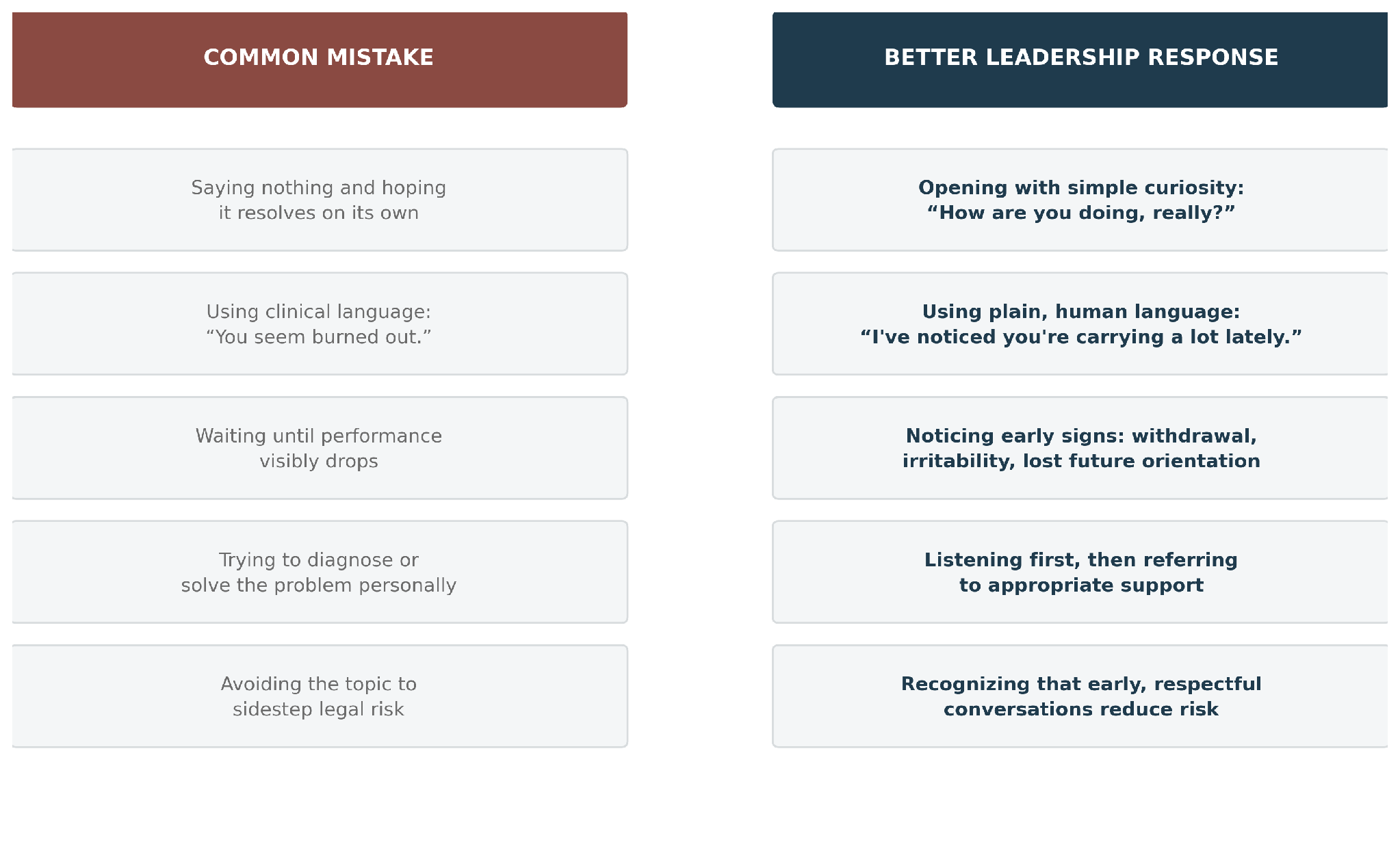
Figure 1. Simple, genuine curiosity is far more effective than clinical language when a manager opens a conversation about strain.
Instead of saying, "You seem burned out," try asking, "I've noticed you've been carrying a lot lately. How are you doing?" Or, "Is there anything making your work more difficult than it needs to be?"
These questions create space for honest conversation without judgment. The goal is not to diagnose. It is to understand. Leaders who listen before they lead build trust before they need it.
What Leaders Should Do First
If you want managers to stop avoiding these conversations, don't start by asking them to care more. They likely already do. Start by giving them a workable structure.
- Replace clinical language with plain, human questions that invite honesty without sounding like a diagnosis.
- Train supervisors to notice early indicators — withdrawal, irritability, declining collaboration — rather than waiting for a visible performance drop.
- Clarify the manager's role explicitly: listen and refer, not diagnose and treat.
- Normalize psychological safety as a leadership skill, not an HR add-on, so managers see it as core to the job rather than extra work.
Early conversations preserve trust. Delayed conversations often preserve problems. The organizations that close this gap aren't the ones with the most caring managers — most managers already care. They're the ones who gave their managers permission, language, and confidence to actually say something.
Take the Anchored Hope Index™
If your managers are avoiding these conversations, your organization may already be absorbing the cost in silence, withdrawal, and Quiet Constraint™. Take the Anchored Hope Index™ to get a clearer, earlier read on trust, communication, and workforce stability across your teams.
Educational Use Disclaimer: The Anchored Hope Index™ is an educational and organizational development tool intended to support reflection, awareness, and discussion. It is not a diagnostic, clinical, or mental health assessment instrument and should not be used as a substitute for professional mental health evaluation or treatment.
Frequently Asked Questions
Why do line managers avoid talking to employees about stress and burnout?
Most managers avoid these conversations out of a lack of confidence, not a lack of compassion. They worry about saying the wrong thing, making the situation worse, creating legal exposure, or being expected to solve a problem outside their role.
How does avoidance make burnout and disengagement worse?
When leaders avoid difficult conversations, employees often conclude their well-being matters less than their output. Over time, trust weakens and Quiet Constraint™ develops — employees keep working but stop sharing ideas, concerns, and discretionary effort.
What should a manager say instead of "You seem burned out"?
Simple, genuine curiosity works better than clinical language. Try: "I've noticed you've been carrying a lot lately. How are you doing?" or "Is there anything making your work more difficult than it needs to be?"
Do managers need clinical training to have these conversations?
No. Managers are not expected to diagnose or treat anything. Their role is to notice early signs of strain, open a supportive conversation, and refer to appropriate resources when needed — not to act as a therapist.
What does THE P.H.O.E.N.I.X. MODEL™ teach managers to notice earlier?
The Perceive phase teaches managers to recognize subtle behavioral changes — emotional withdrawal, declining collaboration, decision fatigue, increased irritability, and loss of future orientation — before burnout becomes visible in performance.
Is manager silence really a widespread problem, or is it isolated to certain industries?
Reporting on Gallup's workplace research found only 44 percent of managers had received formal management training, suggesting the gap is broad rather than isolated to specific sectors.
Can the Anchored Hope Index™ diagnose which employees are burned out?
No. The Anchored Hope Index™ is an educational and organizational development tool. It supports reflection on trust, communication, and workforce stability, but it does not diagnose burnout or any medical or psychological condition.
What is the first step an organization should take to close this gap?
Give managers a workable structure rather than asking them to simply care more. That means plain-language conversation starters, training on early indicators, and clarity that their role is to listen and refer, not diagnose.
References
- Business Insider — reporting on Gallup workplace data, noting that only 44% of managers had received formal management training (businessinsider.com/manager-engagement-gallup-workplace-report-2025-4)
- The Wall Street Journal — reporting on Gallup data describing a rare and significant decline in manager engagement (wsj.com/lifestyle/careers/managers-engagement-work-e50f8f5e)
- U.S. Department of Health and Human Services, Office of the Surgeon General — "Workplace Mental Health & Well-Being," on psychological safety as foundational to workplace well-being (hhs.gov/surgeongeneral/priorities/workplace-well-being)
- Research study on stress factors and reluctance to report burnout to management among high-stress professionals, 2024 (arxiv.org/abs/2409.12047)
- Research on psychological safety in team settings and its effect on team reflexivity and performance (arxiv.org/abs/2109.15034)
- Deep Market Intelligence Report: Enterprise Positioning for THE P.H.O.E.N.I.X. MODEL™ and the Anchored Hope Framework (internal source material)