Right Tool, Wrong Moment: Why Engagement Surveys Fail When Organizations Are in Crisis
Dr. Charles Castillo
Mental Resilience Counseling | THE P.H.O.E.N.I.X. MODEL™
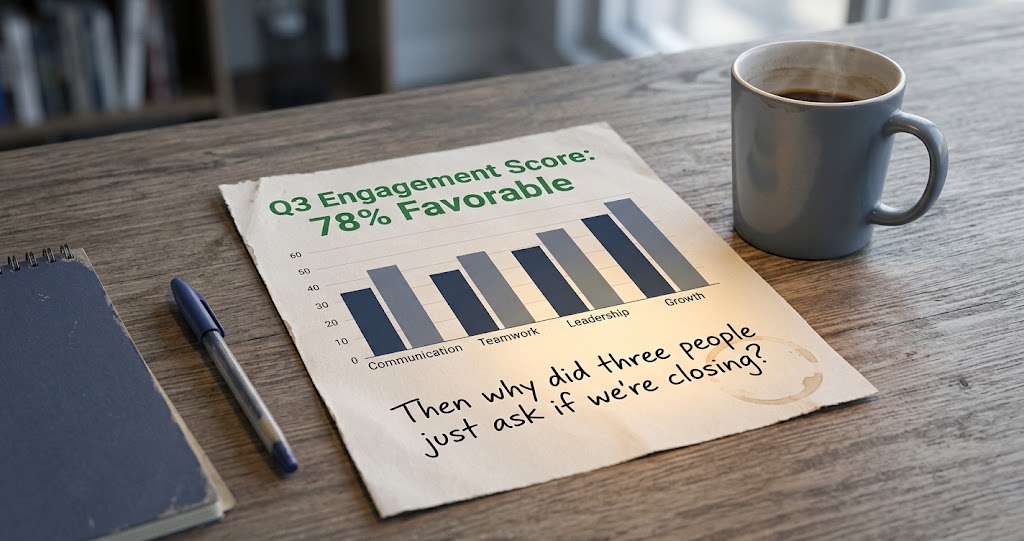
A favorable engagement score during a genuine crisis can produce a strange disconnect — the number says one thing, and everything happening on the floor says another. That gap isn’t a data error. It’s the survey measuring the wrong thing.
Traditional engagement surveys fail in crisis environments because they measure satisfaction and perception, which is a different question than whether people remain connected to the meaningful future that gives them the endurance to stay steady through adversity. As Dr. Charles Castillo puts it, engagement surveys measure satisfaction and perception — they often miss whether people remain connected to the meaningful future that gives them the endurance to stay steady through adversity. A high score during a crisis doesn't mean people are fine. It often means they've stopped believing honest feedback will change anything.
Why Do Traditional Engagement Surveys Fail in Crisis Environments?
Because they measure satisfaction and perception, not endurance or future connection — different questions entirely. During a crisis, employees may respond based on fear, uncertainty, or self-protection, and some underreport concerns because they doubt honest feedback will lead to change. A survey can return a reassuring score while missing the erosion of resilience and stability actually happening underneath it.
Expert Insight — Dr. Charles Castillo
“Engagement surveys measure satisfaction and perception. They often miss whether people remain connected to the meaningful future that gives them the endurance to stay steady through adversity.”
What Do HR Executives Get Wrong About Engagement Data During a Crisis?
The most common error is trusting a favorable score at face value without accounting for how a crisis distorts self-reporting. During a crisis, employees may respond based on fear, uncertainty, or self-protection — others may underreport concerns because they question whether honest feedback will lead to meaningful change. A good score during instability can mean people have simply given up on being heard.
The second error is asking a sentiment tool to do a prediction tool's job. Engagement surveys are valuable for understanding workforce sentiment and identifying areas for improvement — they should not be relied upon as predictive measures of resilience, operational endurance, or future workforce stability. Treating them as if they were is where the false reassurance comes from.
Why Is the Business Consequence Larger Than It Looks?
A misread engagement score during a crisis is uniquely dangerous, because it arrives exactly when leaders most need an accurate signal and are least likely to question a reassuring one. Confidence built on a distorted number tends to collapse suddenly, once reality catches up to it.
NIOSH's Worker Well-Being Questionnaire includes explicit guidance on administration, interpretation, privacy, and ethics — precisely because measurement tools carry real risk when their results are misread or over-relied upon. A RAND review of worksite wellness programs found that much of the reported return in this field rests on observational rather than randomized evidence, reinforcing the need for caution about what any single measurement can reliably predict. A meta-analysis of work-engagement interventions (Knight, Patterson & Dawson, 2017) demonstrates that engagement itself is a well-studied, structured construct — which is exactly why conflating it with resilience or endurance is a category error, not just a shortcut. And a 2026 systematic review of participatory organizational interventions found no statistically significant pooled effect overall, a reminder that self-reported measures are sensitive to context in ways a single survey score can easily obscure.
What Does the Anchored Hope Framework Measure That Surveys Often Miss?
The Anchored Hope Framework measures whether people remain anchored to a meaningful future despite present challenges. The Anchored Hope Index™ provides an early indicator of resilience, workforce stability, and the capacity to endure — before disengagement or turnover becomes visible anywhere else.
That's a genuinely different signal from a satisfaction score, not a better version of the same one. “They often miss whether people remain connected to the meaningful future that gives them the endurance to stay steady through adversity,” as Dr. Castillo puts it — engagement surveys remain valuable for understanding workforce sentiment and identifying areas for improvement; they simply shouldn't carry the weight of predicting resilience or stability on their own.
What Engagement Surveys Measure vs. What the Anchored Hope Index™ Measures
Table 1. Two Different Instruments, Two Different Questions
| Traditional Engagement Surveys | The Anchored Hope Index™ |
|---|---|
| Measures satisfaction and perception | Measures connection to a meaningful future |
| Vulnerable to fear-driven distortion in a crisis | Designed to surface signal even under strain |
| Useful for identifying areas for improvement | Useful as an early indicator of resilience and endurance |
| Not predictive of future stability | Built specifically as a leading, not lagging, signal |
| Most reliable in stable conditions | Valuable specifically during and before instability |
Neither replaces the other — they answer different questions and are most useful side by side. Framing drawn directly from Dr. Charles Castillo’s Money Dialog answers.
What Should HR Leaders Do First?
- Use engagement surveys for what they're actually good at. Sentiment and improvement areas — not prediction. Don't ask a satisfaction tool to forecast resilience or stability.
- Account for crisis-driven distortion when interpreting results. During instability, expect fear, self-protection, and doubt about whether feedback matters to shape how people respond — read scores with that in mind.
- Add a measure of future connection and endurance, not just satisfaction. Take the Anchored Hope Index™ at https://anchoredhopeindex.com alongside your existing engagement survey to see the dimension a satisfaction score alone can't capture.
- Don't treat a favorable score as proof of stability during a crisis. A reassuring number during instability deserves more scrutiny, not less — it may reflect distorted reporting rather than genuine calm.
- Pair sentiment data with a resilience-specific signal for a fuller picture. Neither tool alone tells the whole story; used together, they cover the gap either one leaves on its own.
Take the Anchored Hope Index™
A reassuring engagement score during a crisis can be the most dangerous kind of good news — it's exactly the moment leaders relax when they should be looking closer. Take the Anchored Hope Index™ at https://anchoredhopeindex.com to see the signal a satisfaction score can miss, before the gap between the number and reality becomes impossible to ignore.
Disclaimer
Disclaimer: The Anchored Hope Index™ is an educational and organizational development tool intended to support reflection, awareness, and discussion. It is not a diagnostic, clinical, or mental health assessment instrument and should not be used as a substitute for professional mental health evaluation or treatment.
Frequently Asked Questions
Why do traditional engagement surveys fail in crisis environments?
Because they measure satisfaction and perception, not endurance or future connection. During a crisis, fear, uncertainty, and self-protection distort self-reporting, and a survey can return a reassuring score while missing real instability underneath.
What do engagement surveys usually fail to capture?
They measure satisfaction and perception, but often miss whether people remain connected to the meaningful future that gives them the endurance to stay steady through adversity.
Why do crisis environments distort self-reporting specifically?
During a crisis, employees may respond based on fear, uncertainty, or self-protection. Others may underreport concerns because they question whether honest feedback will lead to meaningful change.
Does this mean we should stop using engagement surveys altogether?
No — that would overcorrect. Engagement surveys are valuable for understanding workforce sentiment and identifying areas for improvement; they just shouldn't be relied upon as predictive measures of resilience, operational endurance, or future workforce stability. Take the Anchored Hope Index™ at https://anchoredhopeindex.com as a complement to your existing survey, not a replacement for it.
What does the Anchored Hope Framework measure that surveys often miss?
Whether people remain anchored to a meaningful future despite present challenges. The Anchored Hope Index™ provides an early indicator of resilience, workforce stability, and the capacity to endure before disengagement or turnover becomes visible.
What should leaders use engagement surveys for, and what shouldn't they rely on them for?
Use them for understanding workforce sentiment and identifying areas for improvement. Don't rely on them as predictive measures of resilience, operational endurance, or future workforce stability.
Is the Anchored Hope Index™ more accurate than an engagement survey?
It's not a competition between the two — they measure different things. The Index is an educational, non-clinical tool focused on future orientation and endurance, not a more accurate version of a sentiment survey.
References
- NIOSH, CDC — Worker Well-Being Questionnaire (WellBQ), Revised May 2024. https://www.cdc.gov/niosh/docs/2021-110/
- Osilla et al. — Systematic Review of the Impact of Worksite Wellness Programs, RAND / American Journal of Managed Care, 2012. https://pubmed.ncbi.nlm.nih.gov/22435887/
- Knight, Patterson & Dawson — Building Work Engagement: A Systematic Review and Meta-Analysis Investigating the Effectiveness of Work Engagement Interventions, Journal of Organizational Behavior, 2017. https://pubmed.ncbi.nlm.nih.gov/28781428/
- Effects of Participatory Organizational Interventions on Mental Health and Work Performance: A Systematic Review and Meta-Analysis, Journal of Occupational Health, 2026. https://pubmed.ncbi.nlm.nih.gov/42011932/