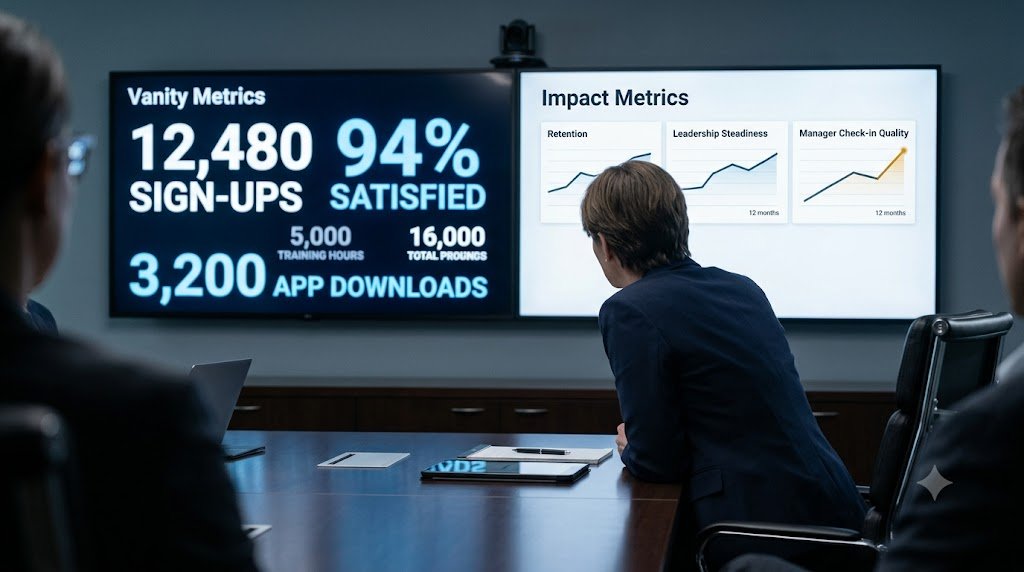
Before You Launch Anything: What to Measure First, and Why Most Baselines Fail
Dr. Charles Castillo
Mental Resilience Counseling | THE P.H.O.E.N.I.X. MODEL™
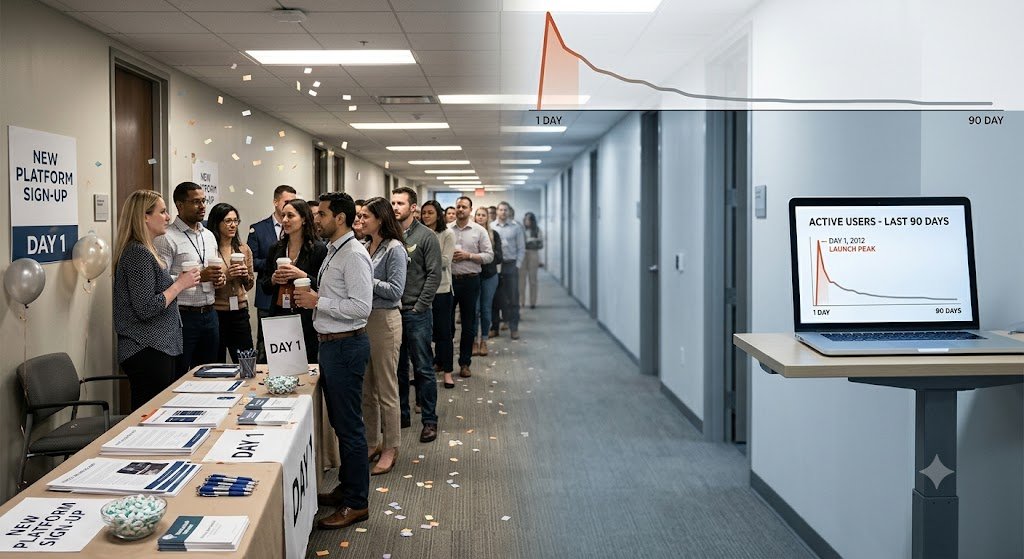
Good intentions and a vague plan to “see how it goes” — that’s how most programs launch. Six months later, there’s no way to say whether anything actually changed, because nothing was measured before it started.
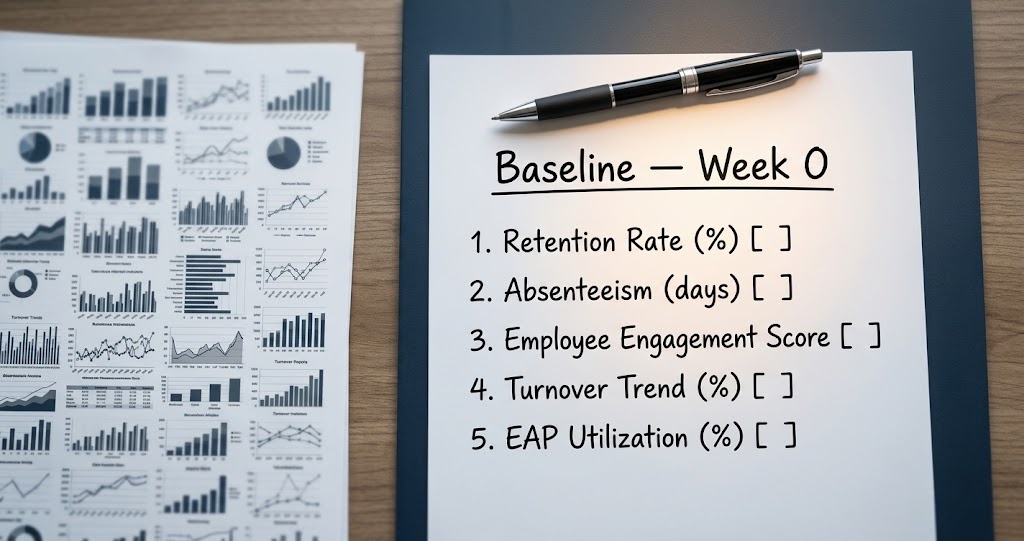
What you should measure before launching a resilience or wellbeing initiative is a small, focused set of indicators captured before anyone participates: the workforce data you already have, like retention and absenteeism, alongside qualitative signals like trust and psychological safety, with success defined in advance rather than after the fact. As Dr. Charles Castillo puts it, you cannot demonstrate progress if you don’t know where you started — a credible baseline turns opinions into evidence and allows HR to measure meaningful change over time.
What Should We Measure Before Launching a Resilience or Employee Wellbeing Initiative?
Measure a focused set of existing workforce indicators — retention, absenteeism, presenteeism, overtime, engagement, turnover trends, EAP utilization — alongside qualitative signals like trust, psychological safety, and future outlook, all captured before anyone participates. Keep individual reflection private and aggregate the rest. Define what success looks like in advance, not after the program ends, and resist the urge to track everything at once.
Expert Insight — Dr. Charles Castillo
“You cannot demonstrate progress if you don’t know where you started. A credible baseline turns opinions into evidence and allows HR to measure meaningful change over time.”
What Do HR Executives Get Wrong About Pre-Program Measurement?
The single most common and costly mistake is launching without a baseline at all. Without one, there’s no way to say later whether anything changed — the organization is left with impressions and anecdotes instead of evidence, no matter how well the program itself was designed.
The second error is overcorrecting into an overwhelming dashboard. Measure what matters most: a small group of meaningful indicators aligned with your goals and business priorities creates clearer insight than a dashboard filled with unnecessary metrics. Beyond that, a handful of specific habits quietly undermine credibility: changing the measures midway through the program, collecting inconsistent data, tracking too many variables, or failing to define success in advance. Consistency, clarity, and discipline are what make the eventual results credible.
Why Is the Business Consequence Larger Than It Looks?
A weak or missing baseline doesn’t just make evaluation harder later — it makes the entire initiative unfalsifiable. Without a credible “before,” any outcome can be claimed as a win, and no outcome can be meaningfully disputed, which is exactly the kind of evidence that collapses under real scrutiny.
The tools for building that baseline already exist and don’t need to be invented. NIOSH’s Quality of Worklife Questionnaire measures workload, staffing, trust, supervisory behavior, job future, presenteeism, intent to leave, overtime, and performance — a ready-made menu of indicators tied to real workplace conditions rather than vague sentiment. The Impact Wellbeing™ Guide, developed by NIOSH with the Dr. Lorna Breen Heroes’ Foundation, provides an evidence-informed, operational framework for leaders to improve workforce wellbeing through organizational action — useful as a model for how baseline data should connect to real implementation, not sit in a report. NIOSH’s Mission Possible guidance reinforces the same discipline: the same measures, applied consistently before and after, are what let an organization compare trends over time rather than guess at them.
How Does the Anchored Hope Index™ Contribute to a Baseline Without Becoming a Diagnosis?
The Anchored Hope Index™ provides a structured way for employees to reflect on hope, resilience, and future orientation at the beginning of a program. Used in aggregate, it helps organizations understand trends and supports meaningful measurement conversations — it is an educational reflection tool, not a clinical or diagnostic instrument, and that distinction has to hold in how the baseline itself is structured, not just in how results are reported later.
That structure follows a simple rule: individual reflection should remain private and protected, while organizational decisions are based on aggregated, de-identified data that reveals workforce trends without identifying individual employees. “A credible baseline turns opinions into evidence and allows HR to measure meaningful change over time,” as Dr. Castillo puts it — and that evidence only holds up if the privacy line is built into the baseline from day one, not added afterward.
The Focused Scorecard vs. the Overwhelming Dashboard
Table 1. Two Ways to Design a Pre-Program Baseline
| The Overwhelming Dashboard | The Focused Scorecard |
|---|---|
| Dozens of metrics tracked at once | A small, deliberately chosen set tied to priorities |
| Measures changed partway through the program | Same measures held consistent start to finish |
| Success defined loosely after results come in | Success defined explicitly before the pilot begins |
| Individual and aggregate data blurred together | Individual reflection private; only aggregate informs decisions |
| Numbers reported with no context for “why” | Quantitative indicators paired with qualitative conversations |
Both approaches can look thorough on paper — only one produces evidence anyone can trust later. Framing drawn directly from Dr. Charles Castillo’s Money Dialog answers.
What Should HR Leaders Do First?
- Start with the workforce data you already have. Review retention, absenteeism, presenteeism, overtime, engagement, turnover trends, EAP utilization, and manager observations before adding anything new.
- Add qualitative signals to explain the ‘why.’ Numbers tell you what is happening; conversations help explain why. Gather feedback on trust, purpose, psychological safety, and future outlook alongside the numbers.
- Keep the scorecard small and deliberate. Select a small group of meaningful indicators aligned with your goals — a focused scorecard beats a dashboard filled with unnecessary metrics every time.
- Separate individual privacy from aggregate insight from day one. Individual reflection should remain private and protected; organizational decisions should rest only on aggregated, de-identified trends. Build that separation into the data structure itself — take the Anchored Hope Index™ at https://anchoredhopeindex.com as one aggregate-only line in your baseline pull, not a separate individual-level record.
- Define success before the pilot begins, and hold the measures steady. Identify the behaviors you hope to influence and the outcomes that would justify expanding the initiative before you start — and don’t change the measures partway through.
Take the Anchored Hope Index™
The operational metrics you’re already tracking can’t tell you how people see their own future — and if that dimension isn’t part of your baseline now, you won’t have it to compare against later, no matter how good your other numbers look. Take the Anchored Hope Index™ at https://anchoredhopeindex.com to add that missing piece before your next initiative launches, not after.
Disclaimer
Disclaimer: The Anchored Hope Index™ is an educational and organizational development tool intended to support reflection, awareness, and discussion. It is not a diagnostic, clinical, or mental health assessment instrument and should not be used as a substitute for professional mental health evaluation or treatment.
Frequently Asked Questions
What should we measure before launching a resilience or employee wellbeing initiative?
A focused set of existing workforce indicators — retention, absenteeism, engagement, turnover trends, EAP utilization — alongside qualitative signals like trust and psychological safety, captured before anyone participates, with success defined in advance.
Why does measurement have to start before the program launches?
You cannot demonstrate progress if you don’t know where you started. A credible baseline turns opinions into evidence and allows HR to measure meaningful change over time — without it, no later result can be meaningfully evaluated.
Should we track qualitative feedback or just hard numbers?
Both. Numbers tell you what is happening; conversations help explain why. Gather feedback on trust, purpose, psychological safety, confidence in leadership, and future outlook alongside the quantitative indicators.
What should stay private, and what can be reviewed in aggregate?
Individual reflection should remain private and protected. Organizational decisions should be based on aggregated, de-identified data that reveals workforce trends without identifying individual employees.
How does the Anchored Hope Index™ contribute to a baseline without being clinical?
It provides a structured way for employees to reflect on hope, resilience, and future orientation at the start of a program. Used in aggregate, it supports measurement conversations as an educational reflection tool, not a clinical or diagnostic instrument.
What mistakes make a baseline unreliable later?
Starting without one, changing the measures midway through the program, collecting inconsistent data, tracking too many variables, or failing to define success in advance. Consistency, clarity, and discipline are what make results credible.
Doesn’t adding the Anchored Hope Index™ contradict your own advice to keep the scorecard small?
No — it consolidates rather than adds. Instead of running several separate qualitative check-ins on trust, purpose, and future outlook, it replaces them with one instrument. Take the Anchored Hope Index™ at https://anchoredhopeindex.com to see it positioned as one line on a focused scorecard, not a sixth category of tracking.
References
- NIOSH, CDC — Worker Well-Being Questionnaire (WellBQ), Revised May 2024. https://www.cdc.gov/niosh/docs/2021-110/
- NIOSH, CDC — Mission Possible: Measuring Worker Well-Being, June 25, 2021. https://www.cdc.gov/niosh/bulletin/2021/wellbq.html
- NIOSH, CDC — Quality of Worklife Questionnaire, Updated March 9, 2026. https://www.cdc.gov/niosh/stress/worklife-question/index.html
- NIOSH, CDC and Dr. Lorna Breen Heroes’ Foundation — Impact Wellbeing™ Guide: Taking Action to Improve Healthcare Worker Wellbeing, Revised July 2024. https://www.cdc.gov/niosh/docs/2024-109/