The 90-Day Cliff: Why Wellbeing Participation Collapses After Launch — and What Actually Keeps It Alive
Dr. Charles Castillo
Mental Resilience Counseling | THE P.H.O.E.N.I.X. MODEL™
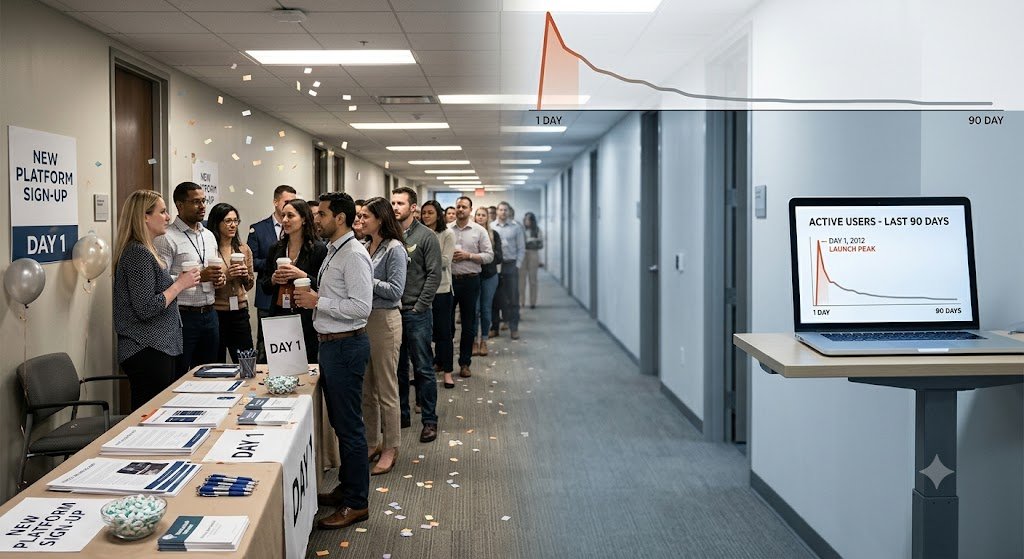
The pattern is almost too familiar to name anymore: a wellbeing program launches to a crowd — strong sign-ups, full sessions, an encouraging satisfaction score — and within a quarter the active-user line has quietly slid toward the floor. The instinct is to blame the employees or the app. The real cause is usually structural.
Wellbeing participation collapses after launch because curiosity fades without connection, because overloaded employees experience each new initiative as one more obligation, and — most decisively — because leaders don’t model it. Launch enthusiasm proves a program is new; it does not prove it is useful. Sustained participation comes from three things: an experience employees find immediately relevant to a real problem, managers and senior leaders who visibly practice it, and a design built for ongoing habit rather than one-time consumption. As Dr. Charles Castillo puts it, declining participation is feedback, not failure.
Why Are Our Wellness-Program Participation Numbers High at Launch but Collapsing Within a Few Months?
Because a launch measures curiosity, not commitment. Employees try something new, then disengage when it doesn’t visibly help or when leaders don’t model it. Declining participation is feedback: it signals the program feels irrelevant, employees are too overloaded to engage, or leadership isn’t reinforcing it. Sustained adoption depends on relevance, manager modeling, and a design that builds habits — not on the size of the launch-week spike.
Expert Insight — Dr. Charles Castillo
“Employees watch leaders more than they listen to them. When managers and senior leaders consistently model healthy behaviors, they give employees permission to do the same. Leadership participation turns a program into part of the culture.”
What Do HR Executives Get Wrong When Participation Fades?
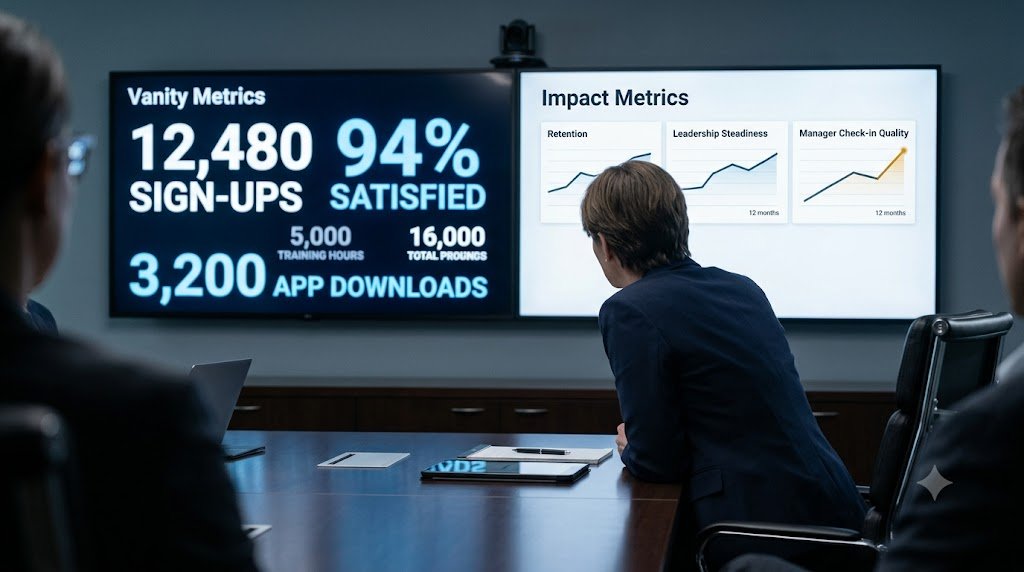
The most common error is treating a strong launch as evidence of lasting adoption. A successful launch creates awareness, not change — and awareness decays fast. When HR celebrates sign-up totals, it mistakes curiosity for commitment and misses the quieter signal that matters: whether anyone is still using the program in month three.
The second error is reading the drop-off as an employee failure. In Dr. Charles’s framing, declining participation is feedback, not failure. It usually means the program stopped feeling relevant, employees are too overloaded to add one more thing, or — most often — leaders aren’t visibly practicing what the program preaches. Employees watch leaders more than they listen to them; when senior leaders don’t model the behavior, staff quietly conclude it isn’t really expected.
This is where “app fatigue” and “initiative fatigue” come from: not laziness, but a workforce already carrying a heavy mental load being handed yet another portal to log into.
Why Is the Business Consequence Larger Than It Looks?
A collapsed program is not a neutral outcome — it is spent budget plus accumulated cynicism. Every initiative that fades teaches employees that the next one will fade too, which raises the cost and lowers the odds of whatever HR launches next. That is the compounding tax of initiative fatigue.
The research reinforces that adoption is a design and context problem, not a marketing one. RAND analyses of workplace wellness programs (Mattke et al., 2015; Huang et al., 2016) found that participation is shaped by program configuration and incentives — that uptake depends on far more than awareness or a good launch campaign. And a 2026 systematic review and meta-analysis of participatory organizational interventions (Journal of Occupational Health) found no statistically significant pooled effect overall, while noting that the studies that did succeed shared structured participation, alignment with real worker needs, and attention to organizational context. In plain terms: what sustains a program isn’t enthusiasm — it’s fit, reinforcement, and design. A related meta-analysis of work-engagement interventions (Knight, Patterson & Dawson, 2017) makes the companion point that effects have to be evaluated, not assumed.
What Does THE P.H.O.E.N.I.X. MODEL™ Do Differently?
Sustained participation is a Harmonize and iNtegrate problem. THE P.H.O.E.N.I.X. MODEL™ is built to embed resilience into daily work rather than deliver it as a one-time event. Through iNtegrate, practices are woven into existing rhythms — check-ins, team meetings, decisions — so using them doesn’t require opening one more app. Through Harmonize, the program aligns with real human bandwidth instead of competing with it, which is what prevents it from becoming just another obligation.
Crucially, the model treats leadership participation as the mechanism, not the garnish. When managers and senior leaders practice the behaviors visibly, adoption stops depending on notifications and starts becoming culture. “Leadership participation turns a program into part of the culture,” Dr. Castillo says — which is why the Anchored Hope Index™ tracks leaders’ modeling alongside employee sentiment, giving HR an aggregate, non-clinical read on whether engagement is deepening or quietly fading, early enough to adjust before the 90-day cliff.
Launch-Driven Adoption vs. Modeled Adoption
Table 1. Why the Standard Approach Fades and What Replaces It
| The Launch-Driven Approach | The Modeled Approach |
|---|---|
| Driven by notifications and reminders | Driven by managers and senior leaders visibly practicing it |
| Delivered as a standalone app or one-time event | Embedded into existing check-ins, meetings, and decisions |
| Success measured by sign-ups and downloads | Success measured by repeat use and application |
| Adds a new obligation to an already full plate | Replaces or consolidates an existing obligation |
| Peaks at launch, fades by month three | Builds steadily as leaders reinforce it over time |
Both columns describe the same program category; the difference is design and reinforcement, not budget. Framing drawn from Dr. Charles Castillo’s Money Dialog answers on manager modeling and program design.
The 30 / 60 / 90-Day Adoption Watch
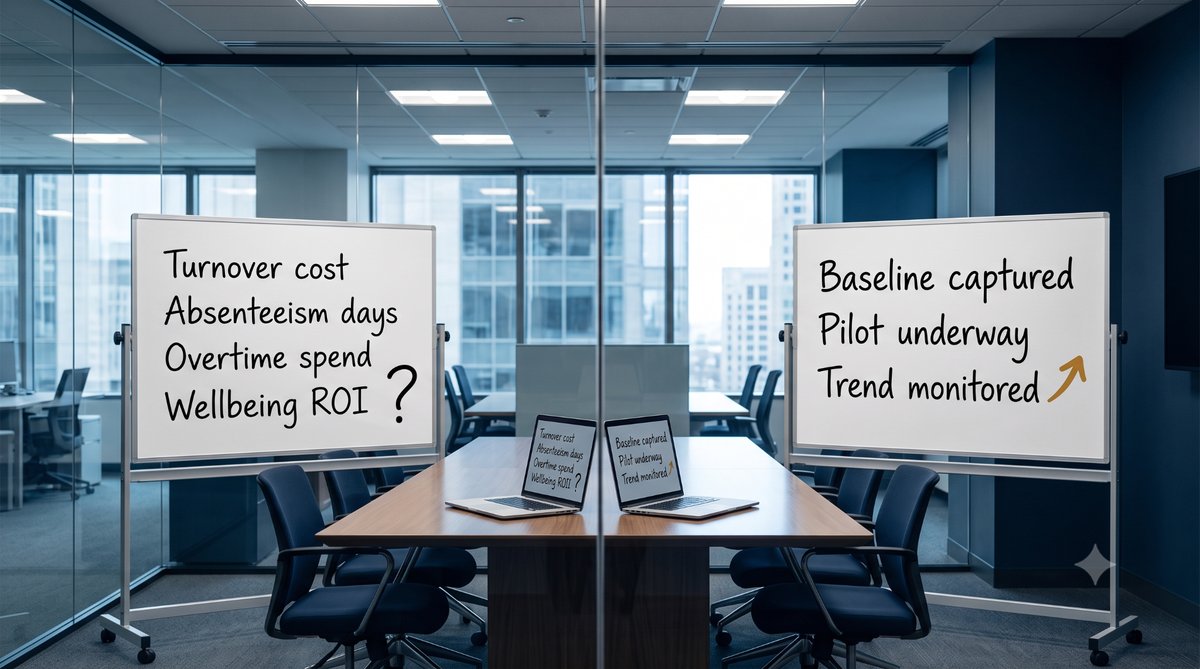
Figure 1. What to Monitor Before Participation Collapses
Instead of tracking attendance, track application and reinforcement:
- Day 30 — Relevance: Are employees reporting that the program solved a real problem? Is repeat (not just first-time) participation holding?
- Day 60 — Reinforcement: Are managers and senior leaders visibly modeling the behavior? Are the skills showing up in check-ins and team conversations?
- Day 90 — Integration: Is the practice embedded in existing workflows, or does it still require a separate app or event? Are you seeing changes in communication, teamwork, and resilience?
A drop in repeat participation or a gap in manager modeling is the earliest warning — long before the active-user line flattens. Adoption drivers per RAND workplace-wellness analyses (Mattke et al., 2015; Huang et al., 2016); monitoring cadence drawn from Dr. Charles Castillo’s Money Dialog answers.
What Should HR Leaders Do First?
- Read the drop-off as feedback. Treat declining participation as data about relevance and reinforcement, not as employee failure.
- Recruit leaders as participants, not sponsors. Ask managers and senior leaders to practice the behavior visibly — have them take the Anchored Hope Index™ at https://anchoredhopeindex.com themselves first, before asking their teams to. Their participation, not their endorsement, is what turns a program into culture.
- Cut, don’t add. Overloaded employees need fewer, more meaningful experiences — not another portal. Retire something for every new thing you introduce.
- Monitor application at 30, 60, and 90 days. Track repeat participation, manager modeling, and whether skills appear in real conversations — the leading indicators of the cliff.
- Design for habit, not consumption. Embed the practice into existing rhythms so using it is the path of least resistance.
Take the Anchored Hope Index™
Momentum usually drifts weeks before a dashboard shows it — by the time your active-user line visibly flattens, the cheap window to intervene has already closed. Take the Anchored Hope Index™ at https://anchoredhopeindex.com for an earlier read than participation counts can give you.
Disclaimer
Disclaimer: The Anchored Hope Index™ is an educational and organizational development tool intended to support reflection, awareness, and discussion. It is not a diagnostic, clinical, or mental health assessment instrument and should not be used as a substitute for professional mental health evaluation or treatment.
Frequently Asked Questions
Why are our participation numbers high at launch but collapsing within a few months?
Because a launch measures curiosity, not commitment. Employees try something new and disengage when it doesn’t visibly help or when leaders don’t model it. Declining participation is feedback — about relevance, overload, or missing reinforcement — not a sign the workforce failed.
Is the drop-off the employees’ fault?
Rarely. Overloaded employees experience each new initiative as another obligation, and they take their cues from leaders. When managers and senior leaders don’t visibly practice the behavior, staff conclude it isn’t truly expected. The fix is reinforcement and relevance, not blame.
What’s the single biggest driver of sustained participation?
Leader modeling. Employees watch leaders more than they listen to them. When managers and senior leaders consistently practice healthy behaviors, they give employees permission to do the same — which turns a program from an announcement into part of the culture.
How do we prevent app fatigue and initiative fatigue?
Add less, not more. A workforce carrying a heavy mental load doesn’t need another portal; it needs fewer, more meaningful experiences that solve a real problem. Retire something for every new thing you launch, and embed practices into existing workflows.
What should we monitor in the first 30, 60, and 90 days?
Track application, not attendance. At day 30, watch relevance and repeat participation; at day 60, watch whether leaders are modeling the behavior; at day 90, watch whether it’s embedded in workflows. A drop in repeat use or a modeling gap is the earliest warning.
Does the Anchored Hope Index™ track individuals or diagnose anyone?
No. It is an educational, non-clinical organizational development tool. Individual responses stay private and are reviewed only in aggregate to reveal trends. It does not diagnose burnout or any medical or psychological condition.
Won’t this just become another app that fades by month three like everything else?
That’s the exact failure pattern this article describes, and it’s avoided by design here: a single, brief, aggregate-only read rather than an ongoing app competing for daily attention. Take the Anchored Hope Index™ at https://anchoredhopeindex.com to see that it’s built to be used once at the start, not opened daily.
References
- Mattke et al. — Workplace Wellness Programs: Services Offered, Participation, and Incentives, RAND Health Quarterly, 2015. https://pubmed.ncbi.nlm.nih.gov/28083383/
- Huang et al. — Incentives, Program Configuration, and Employee Uptake of Workplace Wellness Programs, RAND / Journal of Occupational and Environmental Medicine, 2016. https://pubmed.ncbi.nlm.nih.gov/26716846/
- Knight, Patterson & Dawson — Building Work Engagement: A Systematic Review and Meta-Analysis Investigating the Effectiveness of Work Engagement Interventions, Journal of Organizational Behavior, 2017. https://pubmed.ncbi.nlm.nih.gov/28781428/
- Effects of Participatory Organizational Interventions on Mental Health and Work Performance: A Systematic Review and Meta-Analysis, Journal of Occupational Health, 2026. https://pubmed.ncbi.nlm.nih.gov/42011932/