Breaking the Spiral: How Resilience Investment Reduces Dependence on Traveler Nurses and Contingent Labor
Dr. Charles Castillo
Mental Resilience Counseling | THE P.H.O.E.N.I.X. MODEL™
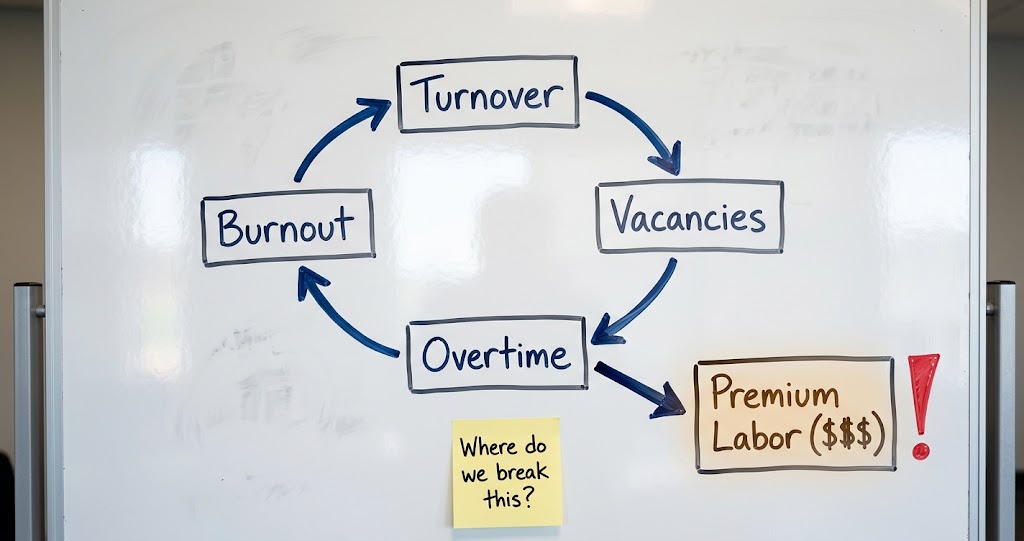
The cycle repeats with almost mechanical predictability in healthcare staffing: a unit loses a few nurses, overtime fills the gap, the overtime burns out the nurses who stayed, and within a quarter the unit is leaning on expensive travelers just to keep the floor staffed. The instinct is to treat premium labor as the fix. It’s actually the symptom.
Resilience investment reduces traveler nurse costs and contingent labor dependence by breaking the cycle that creates the dependence in the first place, rather than treating premium labor as a permanent staffing strategy. As Dr. Charles Castillo puts it, high turnover increases vacancies, vacancies increase overtime, overtime accelerates burnout, and burnout drives more turnover — and organizations often respond with premium labor, creating a costly cycle that becomes difficult to break. You can't spend your way out of a cycle that keeps regenerating the reason you're spending.
How Does Resilience Investment Reduce Traveler Nurse Costs or Contingent Labor Dependence?
It breaks the cycle that creates the dependence. High turnover increases vacancies, vacancies increase overtime, overtime accelerates burnout, and burnout drives more turnover — and premium labor becomes the expensive patch, not the fix. A resilience-centered strategy strengthens leadership, improves workforce endurance, and increases retention; as internal stability improves, dependence on contingent labor naturally begins to decline, rather than being managed indefinitely.
Expert Insight — Dr. Charles Castillo
“High turnover increases vacancies, vacancies increase overtime, overtime accelerates burnout, and burnout drives more turnover. Organizations often respond with premium labor, creating a costly cycle that becomes difficult to break.”
What Do HR Executives Get Wrong About Contingent Labor Dependence?
The most common error is treating traveler dependence as a normal, permanent feature of staffing rather than a symptom. Contingent labor solves an immediate staffing need, but it can also mask deeper organizational issues — excessive reliance on premium labor is often a symptom of workforce instability, not a long-term staffing strategy. Budgeting around it as permanent means never asking what's actually driving the need for it.
The second error is missing the self-reinforcing mechanism entirely. Each staffing crisis gets treated as an isolated event, when in fact high turnover increases vacancies, vacancies increase overtime, overtime accelerates burnout, and burnout drives more turnover. Without seeing the loop, every round of premium labor spending looks like a one-time fix instead of a repeat expense feeding the same underlying cycle.
Why Is the Business Consequence Larger Than It Looks?
The spiral doesn't just repeat — it compounds. Each cycle through turnover, vacancies, overtime, and burnout leaves a more depleted workforce behind it, which makes the next cycle start from a weaker position and often resolve faster into another premium-labor response.
The evidence supports treating this carefully rather than promising a quick fix. A RAND review of worksite wellness programs found that much of the reported return in this field rests on observational rather than randomized evidence — a reason to expect gradual, measurable movement from a resilience investment rather than an overnight elimination of contingent labor. NIOSH's 2021 bulletin on supportive leadership documents a direct relationship between supportive leadership and worker health and wellbeing, directly relevant to where a resilience strategy should start. NIOSH's 2024 call to address work-related psychosocial hazards frames chronic stressors like understaffing and overtime explicitly as organizational risks requiring attention, not individual coping problems. And the WHO's ICD-11 definition of burn-out — a syndrome from chronic, unmanaged workplace stress — names precisely the mechanism sitting at the center of the spiral.
What Does a Resilience-Centered Stability Strategy Improve First?
A resilience-centered strategy strengthens leadership, improves workforce endurance, increases retention, and reinforces anchored hope. As internal stability improves, dependence on contingent labor naturally begins to decline — the strategy doesn't target the premium-labor line item directly; it targets the conditions generating the need for it.
That connection between endurance and cost is direct, not incidental. Workforce endurance protects organizational capacity — when employees remain engaged, resilient, and connected to a meaningful future, organizations reduce turnover, preserve institutional knowledge, and improve financial performance by lowering avoidable labor costs. “Organizations often respond with premium labor, creating a costly cycle that becomes difficult to break,” as Dr. Castillo puts it — endurance is what interrupts that response before it becomes automatic.
The Premium Labor Cycle vs. The Resilience-Centered Cycle
Table 1. Two Self-Reinforcing Loops
| The Premium Labor Cycle | The Resilience-Centered Cycle |
|---|---|
| Turnover creates vacancies | Retention reduces vacancies |
| Vacancies drive overtime | Stable staffing reduces reliance on overtime |
| Overtime accelerates burnout | Leadership support and endurance reduce burnout risk |
| Burnout drives more turnover | Engagement and anchored hope sustain retention |
| Premium labor becomes the ongoing patch | Contingent labor dependence naturally declines over time |
Both are self-reinforcing loops — one compounds the cost, the other compounds the stability. Framing drawn directly from Dr. Charles Castillo’s Money Dialog answers.
What Should HR Leaders Do First?
- Name contingent labor dependence as a symptom, not a strategy. Excessive reliance on premium labor is often a symptom of workforce instability, not a long-term staffing plan — budget and talk about it accordingly.
- Map your own version of the spiral. Identify specifically where turnover, vacancies, overtime, and burnout are reinforcing each other in your organization, rather than treating each staffing crisis as unrelated to the last.
- Strengthen leadership and workforce endurance first. Take the Anchored Hope Index™ at https://anchoredhopeindex.com to establish a baseline read on whether your workforce is still connected to the meaningful future that sustains retention, before you evaluate whether the spiral is breaking.
- Measure retention and institutional knowledge, not just premium labor spend. Cost reduction is a lagging outcome of stability, not a direct target — track the conditions that produce it, not only the line item you want to shrink.
- Expect gradual decline in contingent dependence, not instant elimination. Avoid overpromising causation; a resilience strategy interrupts the cycle over time, it doesn't eliminate premium labor need overnight.
Take the Anchored Hope Index™
Every quarter the spiral runs unaddressed, the next round of turnover, overtime, and burnout gets a little more entrenched — and the premium labor bill that was supposed to be temporary quietly becomes the new baseline. Take the Anchored Hope Index™ at https://anchoredhopeindex.com to get a read on workforce endurance before the next staffing crisis forces another expensive patch.
Disclaimer
Disclaimer: The Anchored Hope Index™ is an educational and organizational development tool intended to support reflection, awareness, and discussion. It is not a diagnostic, clinical, or mental health assessment instrument and should not be used as a substitute for professional mental health evaluation or treatment.
Frequently Asked Questions
How does resilience investment reduce traveler nurse costs or contingent labor dependence?
By breaking the cycle that creates the dependence: turnover increases vacancies, vacancies increase overtime, overtime accelerates burnout, and burnout drives more turnover. A resilience-centered strategy strengthens leadership and endurance, and dependence on contingent labor naturally begins to decline as stability improves.
Why do organizations treat traveler dependence as normal instead of symptomatic?
Contingent labor solves an immediate staffing need, but it can also mask deeper organizational issues. Excessive reliance on premium labor is often a symptom of workforce instability, not a long-term staffing strategy.
How does instability create a financial spiral around premium labor?
High turnover increases vacancies, vacancies increase overtime, overtime accelerates burnout, and burnout drives more turnover. Organizations often respond with premium labor, creating a costly cycle that becomes difficult to break.
Won’t we still need some contingent labor no matter what, given how competitive healthcare staffing is?
Likely yes, and that's a different claim than what's being made here — the goal is reducing dependence on premium labor as the default response to instability, not eliminating contingent staffing entirely. Take the Anchored Hope Index™ at https://anchoredhopeindex.com to track whether that internal stability is actually moving in the right direction.
What does a resilience-centered stability strategy improve first?
It strengthens leadership, improves workforce endurance, increases retention, and reinforces anchored hope. As internal stability improves, dependence on contingent labor naturally begins to decline.
How should leaders connect workforce endurance to labor cost control?
Workforce endurance protects organizational capacity. When employees remain engaged, resilient, and connected to a meaningful future, organizations reduce turnover, preserve institutional knowledge, and improve financial performance by lowering avoidable labor costs.
Can we expect contingent labor spend to drop immediately after investing in resilience?
No, and it shouldn't be framed that way. Much of the evidence in this field is observational rather than randomized, so expect gradual, measurable movement over time rather than an immediate before-and-after result.
References
- Osilla et al. — Systematic Review of the Impact of Worksite Wellness Programs, RAND / American Journal of Managed Care, 2012. https://pubmed.ncbi.nlm.nih.gov/22435887/
- NIOSH, CDC — Supportive Leaders Drive Organizational Improvements and Employee Health and Well-Being, October 13, 2021. https://www.cdc.gov/niosh/bulletin/2021/supportive-leaders.html
- NIOSH, CDC — An Urgent Call to Address Work-Related Psychosocial Hazards and Improve Worker Well-Being, April 10, 2024. https://www.cdc.gov/niosh/bulletin/2024/workplace-psychosocial-hazards.html
- World Health Organization — Burn-out an Occupational Phenomenon, ICD-11 guidance. https://www.who.int/standards/classifications/frequently-asked-questions/burn-out-an-occupational-phenomenon