You Don’t Have to Promise a Better Tomorrow: Rebuilding Hope for Frontline Staff Facing Funding Cuts
Dr. Charles Castillo
Mental Resilience Counseling | THE P.H.O.E.N.I.X. MODEL™
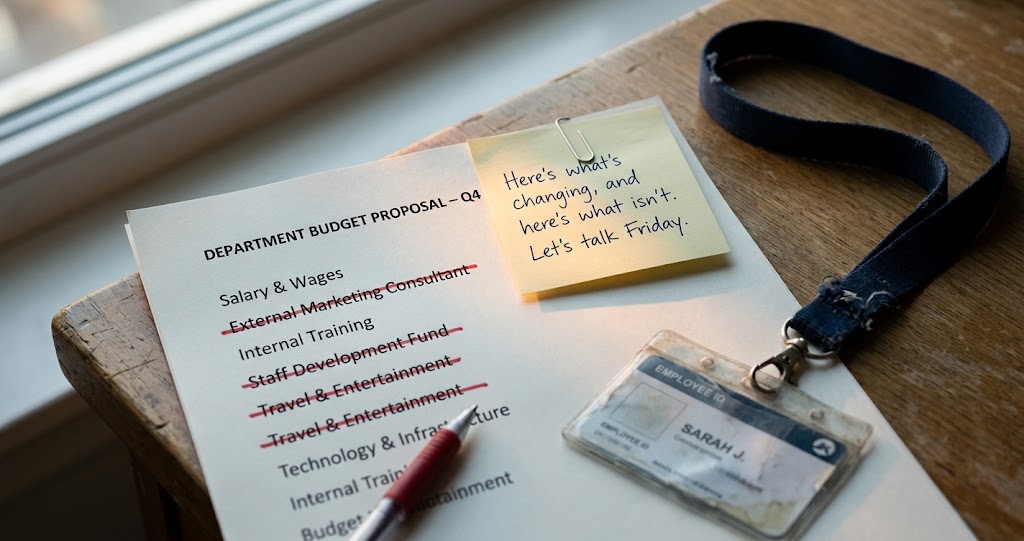
What do you say to a frontline team that already senses funding cuts coming, before anything’s officially been announced? Whatever gets said next either builds trust or spends the last of it.
You rebuild hope for frontline staff when funding cuts are imminent not by promising things will be fine, but by being honest about what's changing, consistent in how you lead through it, and clear about what still matters. As Dr. Charles Castillo puts it, hope becomes credible when it is grounded in honesty, consistent leadership, and a meaningful future — leaders do not have to promise a better tomorrow, they must provide a reason to keep moving toward it. That's a lower bar than false certainty, and a much more achievable one.
How Do We Rebuild Hope for Frontline Staff When Funding Cuts Are Imminent?
Rebuild it through honesty, not reassurance. Funding uncertainty threatens more than budgets — it creates uncertainty about security, purpose, and the future, and morale declines when people question what lies ahead. Hope becomes credible when grounded in honesty, consistent leadership, and a meaningful future. Leaders don't have to promise a better tomorrow; they have to give people a real reason to keep moving toward one.
Expert Insight — Dr. Charles Castillo
“Hope becomes credible when it is grounded in honesty, consistent leadership, and a meaningful future. Leaders do not have to promise a better tomorrow. They must provide a reason to keep moving toward it.”
What Do Leaders Get Wrong When Trying to ‘Encourage’ People Through Cuts?
The most common error is minimizing the reality. Leaders lose credibility when they minimize reality or offer empty reassurance — frontline staff who already sense the pressure notice immediately when the message doesn't match what they're actually experiencing, and the mismatch costs more trust than the honest version would have.
The second error is reaching for unrealistic optimism instead of clear direction. People respond better to transparency, empathy, and a clear direction than to unrealistic optimism — a confident promise that doesn't hold up erodes credibility faster than an honest acknowledgment of a hard situation ever would.
Why Is the Business Consequence Larger Than It Looks?
Funding uncertainty threatens more than budgets. It creates uncertainty about security, purpose, and the future — and when people question what lies ahead, morale and commitment begin to decline well before any cut actually takes effect. The damage starts in the anticipation, not the announcement.
The U.S. Surgeon General's Framework names Mattering at Work and Connection and Community as core organizational essentials — precisely what funding pressure threatens first, since it raises real questions about whether the work and the people doing it still matter to the organization. NIOSH's 2024 call to address work-related psychosocial hazards frames chronic uncertainty explicitly as an organizational risk requiring direct attention, not something individuals should simply cope with. The WHO's ICD-11 definition of burn-out names increased mental distance or cynicism toward one's job as a defining feature — the exact drift that sets in when leaders go quiet during a funding crisis. And NIOSH's 2024 guidance on workplace mental health recommends organizational fixes and supportive supervision together, reinforcing that this isn't a problem individual employees should be left to manage on their own.
How Does THE P.H.O.E.N.I.X. MODEL™ Help Workers Remain Connected to Meaning When the System Feels Unstable?
THE P.H.O.E.N.I.X. MODEL™ helps people strengthen their anchored hope by reconnecting them to the purpose, values, and meaningful future that remain within their control. While organizations cannot eliminate every storm, they can help people remain steady enough to navigate it together.
That distinction — steadying people through a storm rather than pretending the storm isn't real — is what makes the model different from empty encouragement. “Leaders do not have to promise a better tomorrow. They must provide a reason to keep moving toward it,” as Dr. Castillo puts it — reconnecting people to what remains within their control is exactly that reason.
Minimizing Reality vs. Honest, Grounded Hope
Table 1. Two Leadership Responses to the Same Funding Crisis
| Minimizing Reality | Honest, Grounded Hope |
|---|---|
| “Everything will be fine” | “Here's what's changing, and here's what isn't” |
| Avoids hard conversations until forced | Initiates honest conversations before they're forced |
| Reassurance not backed by any real plan | Direction backed by consistent leadership over time |
| Feels good for a day, erodes trust over weeks | Builds credibility precisely because it doesn't overpromise |
| Leaves people to brace for the worst alone | Helps people navigate the hard period together |
Both responses come from wanting to help — only one actually holds up once reality arrives. Framing drawn directly from Dr. Charles Castillo’s Money Dialog answers.
What Should HR Leaders Do First?
- Be honest about what's changing before people have to ask. Waiting for staff to ask directly means they've already been living with unaddressed uncertainty — get ahead of the question.
- Name what remains stable and meaningful, even amid the cuts. Give people something specific and real to hold onto, not a vague sense that things will work out.
- Lead with empathy and clear direction, not unrealistic optimism. Take the Anchored Hope Index™ at https://anchoredhopeindex.com to get an honest, aggregate read on where your frontline teams stand right now, so your direction is grounded in reality rather than assumption.
- Reconnect people to purpose and values that remain within their control. Even when resources and outcomes are uncertain, the reasons people chose this work in the first place often aren't — anchor to those.
- Show up consistently through the hard period, not just at the announcement. A single honest message doesn't sustain hope on its own; ongoing, steady presence through the uncertainty is what makes it credible.
Take the Anchored Hope Index™
Frontline staff who already sense funding cuts coming are watching closely for how leadership responds — and a single instance of minimized reality or empty reassurance can cost more trust than the cuts themselves. Take the Anchored Hope Index™ at https://anchoredhopeindex.com before your next announcement, so you know where hope is already fragile and where it still has room to hold.
Disclaimer
Disclaimer: The Anchored Hope Index™ is an educational and organizational development tool intended to support reflection, awareness, and discussion. It is not a diagnostic, clinical, or mental health assessment instrument and should not be used as a substitute for professional mental health evaluation or treatment.
Frequently Asked Questions
How do we rebuild hope for frontline staff when funding cuts are imminent?
Through honesty, not reassurance. Be honest about what's changing, consistent in how you lead through it, and clear about what remains meaningful. Leaders don't have to promise a better tomorrow — they have to provide a reason to keep moving toward one.
Why does funding pressure hit frontline morale so hard?
Funding uncertainty threatens more than budgets. It creates uncertainty about security, purpose, and the future, and when people question what lies ahead, morale and commitment begin to decline.
What makes hope believable in a genuinely hard environment?
Hope becomes credible when it is grounded in honesty, consistent leadership, and a meaningful future — not when it's grounded in a promised outcome nobody can guarantee.
If we genuinely can't promise things will get better, isn't honesty just going to make people more anxious?
Less than the alternative. People already sense the pressure is real; minimizing it or offering empty reassurance costs leaders credibility without reducing anyone's anxiety. Leaders don't have to promise a better tomorrow — they have to provide a reason to keep moving toward it, which is honest and steadying at the same time. Take the Anchored Hope Index™ at https://anchoredhopeindex.com to see where that reason still needs to be rebuilt for your frontline teams.
What mistakes do leaders make when trying to ‘encourage’ people through cuts?
Leaders lose credibility when they minimize reality or offer empty reassurance. People respond better to transparency, empathy, and a clear direction than to unrealistic optimism.
How does THE P.H.O.E.N.I.X. MODEL™ help workers stay connected to meaning during instability?
It helps people strengthen anchored hope by reconnecting them to purpose, values, and a meaningful future that remain within their control — organizations can't eliminate every storm, but they can help people navigate it together.
Is the Anchored Hope Index™ meant to predict who will leave during a funding crisis?
No. It's an educational, non-clinical organizational development tool that reflects aggregate trends in hope and future orientation, not an individual prediction tool or a substitute for honest leadership communication.
References
- Office of the U.S. Surgeon General, U.S. Department of Health and Human Services — Framework for Workplace Mental Health and Well-Being, 2022 (page reviewed January 24, 2025). https://www.hhs.gov/surgeongeneral/reports-and-publications/workplace-well-being/index.html
- NIOSH, CDC — An Urgent Call to Address Work-Related Psychosocial Hazards and Improve Worker Well-Being, April 10, 2024. https://www.cdc.gov/niosh/bulletin/2024/workplace-psychosocial-hazards.html
- World Health Organization — Burn-out an Occupational Phenomenon, ICD-11 guidance. https://www.who.int/standards/classifications/frequently-asked-questions/burn-out-an-occupational-phenomenon
- NIOSH, CDC — Supporting Mental Health in the Workplace, April 15, 2024. https://www.cdc.gov/niosh/bulletin/2024/mental-health-work.html