Attendance Is Not Impact: How to Prove Your Employee Wellbeing Investment Is Actually Working
Dr. Charles Castillo
Mental Resilience Counseling | THE P.H.O.E.N.I.X. MODEL™
A CHRO stands in front of a budget committee with a folder full of attendance sheets and satisfaction scores, and hears the same blunt question every time: prove it worked. The numbers in that folder don’t actually answer it — they measure whether people showed up, not whether anything changed.
You prove that an employee wellbeing investment is producing measurable business value by defining success before the program begins, establishing a baseline of the behaviors and workforce trends you intend to influence, and then measuring what actually shifted against that baseline — retention, leadership steadiness, engagement, and healthier decision-making — while being honest that many factors shape those outcomes. Value shows up as sustained behavioral change, not participation. As Dr. Charles Castillo frames it, the question is not “how many attended,” but “what changed because they attended.”
How Can I Prove Our Employee Wellbeing Investment Is Producing Measurable Business Value?
Prove it by measuring change against a baseline, not activity. Before launch, capture retention, absenteeism, engagement, leadership confidence, and psychological safety. After launch, track how those move, and report the program’s contribution rather than claiming sole causation. Participation shows exposure; business value shows up as sustained behavior change — employees who respond instead of react, leaders who stay steady, and teams that plan for the future rather than merely survive it.
Expert Insight — Dr. Charles Castillo
“Attendance measures presence, not progress. Satisfaction reflects opinion, not transformation. Organizational value comes from sustained behavioral change, healthier decision-making, stronger leadership, and a more resilient workforce.”
What Do HR Executives Get Wrong About Proving Wellbeing Value?
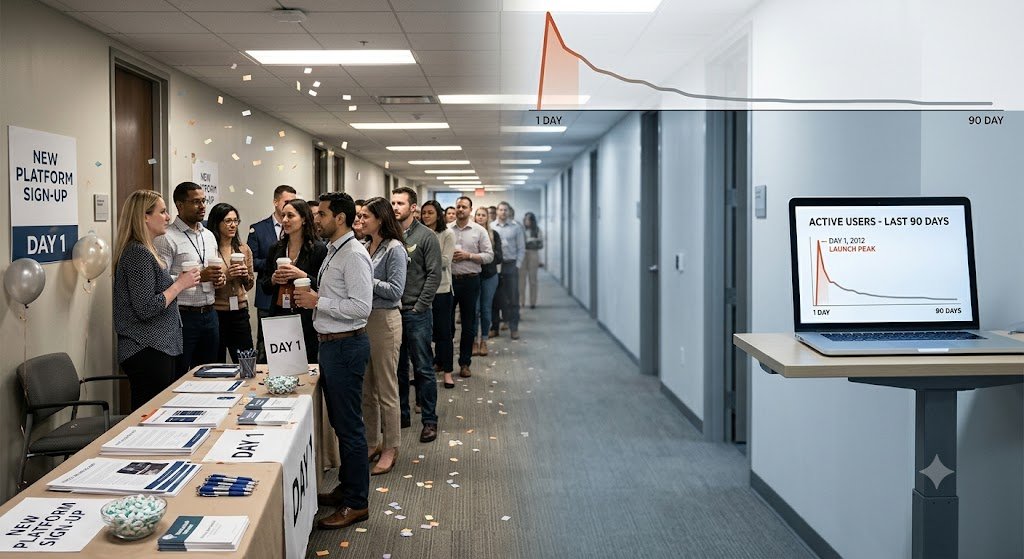
Most reach for the metrics that are easiest to collect. Participation, attendance, and satisfaction are clean, fast, and available the morning after a launch — which is exactly why they mislead. They form what senior HR leaders privately call the “participation mirage”: a dashboard that looks like proof but measures only exposure.
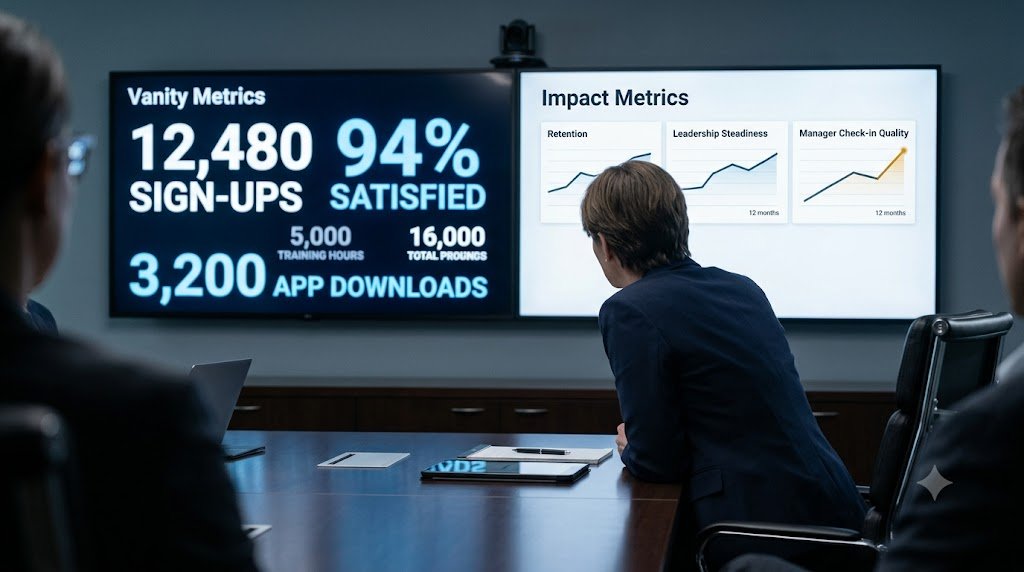
Dr. Charles’s answers are blunt on this point — attendance measures presence, not progress; satisfaction reflects opinion, not transformation. A workforce can attend every session, rate it four out of five, and behave no differently under pressure the following quarter. When the CFO asks what the organization got for its money, “94% satisfaction” is not an answer; it describes a feeling, not a change in how people lead, decide, collaborate, or stay.
The deeper mistake is timing. Programs that wait until the end to ask “did it work?” have already lost the ability to answer, because no one captured where the organization started.
Why Is the Business Consequence Larger Than It Looks?
The cost of weak measurement is not just an awkward budget review. It is misallocated capital and lost credibility. When HR cannot distinguish a program that changed behavior from one that merely generated logins, the organization keeps funding activity and defunding impact — and the executive who signed off loses standing in the room where next year’s budget is decided.
It is worth being precise about the evidence, because overclaiming is its own risk. A widely cited RAND review of worksite wellness programs (Osilla et al., American Journal of Managed Care, 2012) found that much of the reported return rests on observational rather than randomized evidence — meaning the “proof” many vendors wave around is weaker than executives assume. The honest response is not to abandon measurement but to sharpen it: distinguish promising movement from proven causation, and never present a correlation as a guarantee.
There is a constructive side too. The U.S. Surgeon General’s Framework for Workplace Mental Health and Well-Being (2022) identifies the organizational conditions that actually move the needle — protection from harm, connection, work-life harmony, mattering, and opportunity for growth — which tells HR leaders what to measure: not whether people used an app, but whether those conditions improved. NIOSH’s Worker Well-Being Questionnaire and its companion guidance make the same operational point — the same measures, applied before and after, are what turn opinion into evidence.
What Does THE P.H.O.E.N.I.X. MODEL™ See First?
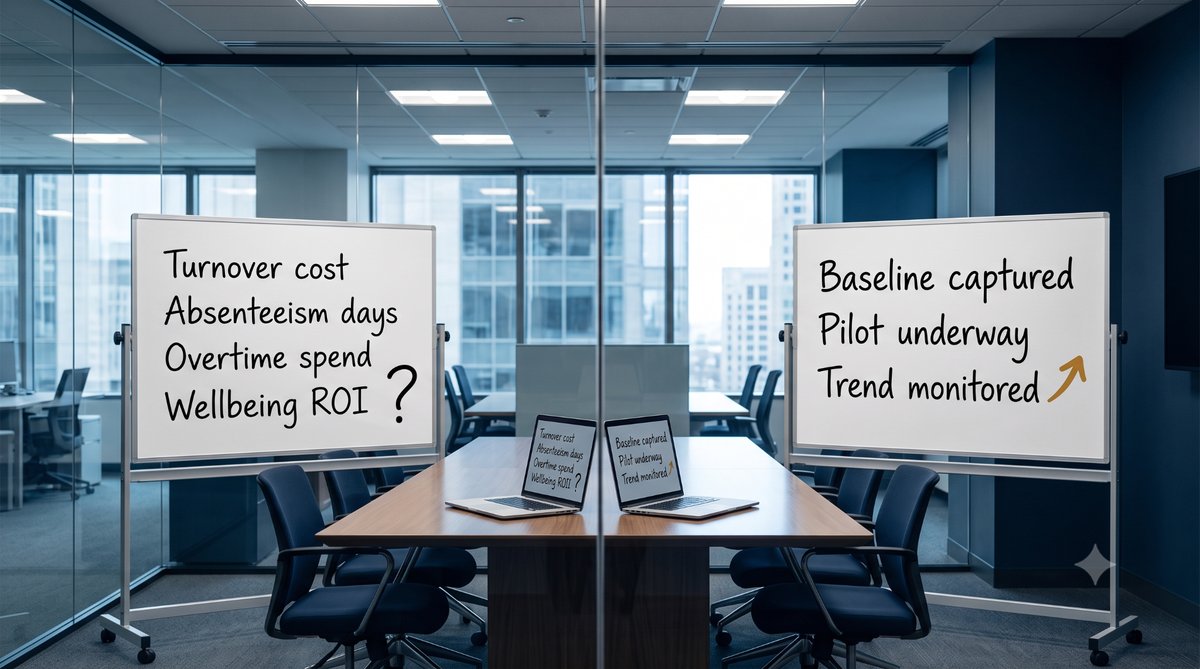
Measurement is a Perceive problem before it is a reporting problem. THE P.H.O.E.N.I.X. MODEL™ begins with Perceive — the discipline of noticing organizational fatigue, trust erosion, and drift early, while there is still time to act and still a baseline worth capturing. A program that starts by perceiving where the workforce actually stands gives HR the one thing a year-end report cannot manufacture: a credible “before.”
The Anchored Hope Index™ operates as that baseline instrument. Used at the start of an initiative and again later, in aggregate, it offers a consistent, non-clinical read on purpose, trust, and future orientation — the human signals that tend to move before retention and engagement numbers do. It does not diagnose anyone; it gives leaders an early, comparable read they can track over time. “Organizational value comes from sustained behavioral change, healthier decision-making, stronger leadership, and a more resilient workforce,” Dr. Castillo says — which is exactly what a well-designed baseline is built to detect.
Activity Metrics vs. Outcome Metrics
Table 1. What Most Programs Report vs. What Proves Value
| Activity Metrics (Exposure) | Outcome Metrics (Value) |
|---|---|
| Sign-ups and attendance | Retention and voluntary-turnover trend |
| Satisfaction scores | Leadership steadiness under pressure |
| App downloads / logins | Manager check-in quality and consistency |
| Sessions completed | Employees who respond instead of react |
| Launch-week enthusiasm | Sustained application months after launch |
Both columns are worth collecting, but only the right column answers a CFO. Framing drawn from Dr. Charles Castillo’s Money Dialog answers; organizational conditions per the U.S. Surgeon General’s Framework for Workplace Mental Health and Well-Being (2022).
What Should HR Leaders Do First?
- Define success before you launch. Write down the specific behaviors and workforce trends the program is meant to influence. Success defined after the fact is not evidence; it is a story.
- Set a real baseline. Capture retention, absenteeism, engagement, leadership confidence, and psychological safety before anyone attends anything — add the Anchored Hope Index™ at https://anchoredhopeindex.com as one line in that same data pull, not a separate project. You cannot measure growth without knowing where you started.
- Choose a focused scorecard, not a dashboard. A small set of meaningful indicators tied to business priorities beats fifty metrics no one acts on.
- Measure application, not attendance. At 30, 60, and 90 days, track whether skills are being used — in check-ins, decisions, and team behavior — not whether seats were filled.
- Report contribution, not causation. Show measurable movement alongside an honest acknowledgment that multiple factors drive outcomes. Credibility with a CFO comes from precision, not overclaiming.
Take the Anchored Hope Index™
The budget conversation about this program’s value is coming again next cycle, whether or not you’re ready for it. Without a captured “before,” you’ll be defending it on impressions the same way you did last time. Take the Anchored Hope Index™ at https://anchoredhopeindex.com now, so next cycle’s conversation starts from evidence instead of memory.
Disclaimer
Disclaimer: The Anchored Hope Index™ is an educational and organizational development tool intended to support reflection, awareness, and discussion. It is not a diagnostic, clinical, or mental health assessment instrument and should not be used as a substitute for professional mental health evaluation or treatment.
Frequently Asked Questions
How can I prove our employee wellbeing investment is producing measurable business value?
Measure change against a baseline rather than activity. Define the behaviors and workforce trends you want to influence, capture them before launch, and then track how retention, leadership steadiness, and engagement move afterward — reporting the program’s contribution rather than claiming it caused every result.
Why aren’t participation and satisfaction scores enough?
They measure exposure, not change. People can attend everything and rate it highly while behaving identically under pressure the next quarter. Attendance measures presence, not progress; satisfaction reflects opinion, not transformation. Business value shows up as sustained behavioral change.
What should we measure before a program begins?
Establish a baseline: retention, absenteeism, engagement, leadership confidence, and psychological safety as they stand today. A credible “before” is the single thing a year-end report cannot reconstruct, and it converts every later result into evidence.
Isn’t wellbeing ROI already proven by industry studies?
Be cautious here. A RAND review of worksite wellness programs found much of the reported return rests on observational rather than randomized evidence, so confident ROI figures are often weaker than they appear. Measure honestly, and distinguish promising movement from proven causation.
Can hope or purpose really be tied to business outcomes without overstating it?
Yes, carefully. Hope and purpose are not business outcomes themselves, but they influence behaviors that affect them. Measure observable changes in engagement, retention, collaboration, and leadership consistency, and acknowledge that many factors contribute to organizational performance.
Is the Anchored Hope Index™ a clinical or diagnostic tool?
No. It is an educational and organizational development tool that supports reflection on purpose, trust, and future orientation. Individual responses stay private and are reviewed only in aggregate. It does not diagnose burnout or any medical or psychological condition.
Isn’t this just one more unproven metric added to a pile of unproven wellbeing metrics?
No — it’s designed to measure something your existing operational data can’t: how employees see their own future, which tends to shift before retention or engagement numbers do. Take the Anchored Hope Index™ at https://anchoredhopeindex.com to see the specific dimensions it adds beyond what you’re already tracking.
References
- NIOSH, CDC — Worker Well-Being Questionnaire (WellBQ), Revised May 2024. https://www.cdc.gov/niosh/docs/2021-110/
- NIOSH, CDC — Mission Possible: Measuring Worker Well-Being, June 25, 2021. https://www.cdc.gov/niosh/bulletin/2021/wellbq.html
- Osilla et al. — Systematic Review of the Impact of Worksite Wellness Programs, RAND / American Journal of Managed Care, 2012. https://pubmed.ncbi.nlm.nih.gov/22435887/
- Office of the U.S. Surgeon General, U.S. Department of Health and Human Services — Framework for Workplace Mental Health and Well-Being, 2022 (page reviewed January 24, 2025). https://www.hhs.gov/surgeongeneral/reports-and-publications/workplace-well-being/index.html