The Program Ended — Now What? How to Demonstrate Improvement Without Overclaiming It
Dr. Charles Castillo
Mental Resilience Counseling | THE P.H.O.E.N.I.X. MODEL™
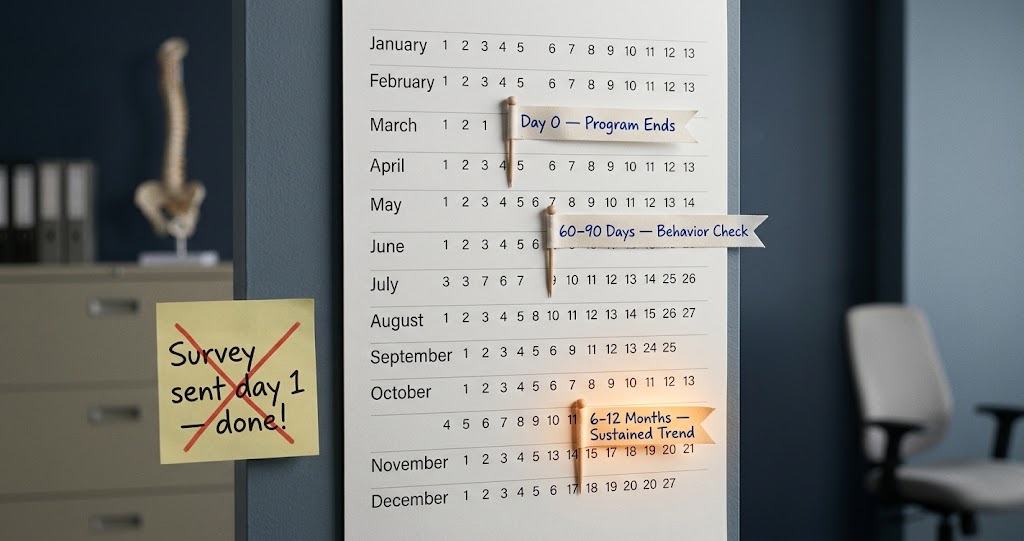
A satisfaction survey. A few enthusiastic testimonials. A vague sense that it went well. That’s how most programs close out — and when someone asks six months later what actually changed, that’s not evidence. It’s a feeling.
You demonstrate improvement after a wellness or resilience program ends by comparing results to the same baseline measures you set before it started, evaluating in phases rather than all at once, and reporting contribution honestly rather than claiming the program alone caused every result. As Dr. Charles Castillo puts it, compare the results to your original baseline — the question isn’t ‘did people attend,’ it’s ‘what changed,’ and answering that means looking at behavior, trust, and workforce trends against where you started, not just how the room felt on the last day.
How Do We Demonstrate Improvement After a Wellness or Resilience Program Ends?
Compare results to your original baseline, not to general impressions. Look for changes in employee behaviors, engagement, resilience, trust, leadership effectiveness, communication, and workforce trends, evaluated in phases: immediate learning at completion, behavioral application at 60 to 90 days, and sustained trends at six to twelve months. Use the same measures you started with, and report contribution honestly rather than claiming sole causation.
Expert Insight — Dr. Charles Castillo
“Compare the results to your original baseline. Look for changes in employee behaviors, engagement, resilience, trust, leadership effectiveness, communication, and workforce trends. The question isn’t, ‘Did people attend?’ It’s, ‘What changed?’”
What Do HR Executives Get Wrong About Post-Program Evaluation?
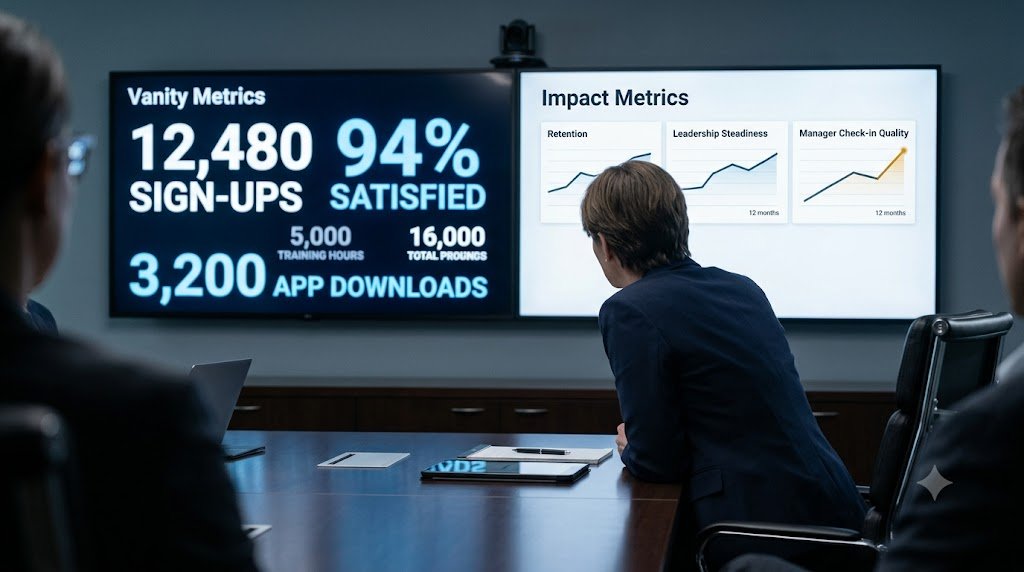
The most common error is treating testimonials and satisfaction scores as proof. They provide valuable stories, and satisfaction reflects the participant’s experience, but neither proves lasting change — they should complement objective measures, not replace them. A glowing quote from one engaged participant says nothing about whether the workforce, on average, behaves differently three months later.
The second error is evaluating once, right at program completion, and calling it done. Lasting change takes time: immediate learning at completion looks different from behavioral application at 60 to 90 days, which looks different again from sustained organizational trends six to twelve months out. Measuring only the first phase and reporting it as the whole story overstates what’s actually been shown.
Why Is the Business Consequence Larger Than It Looks?
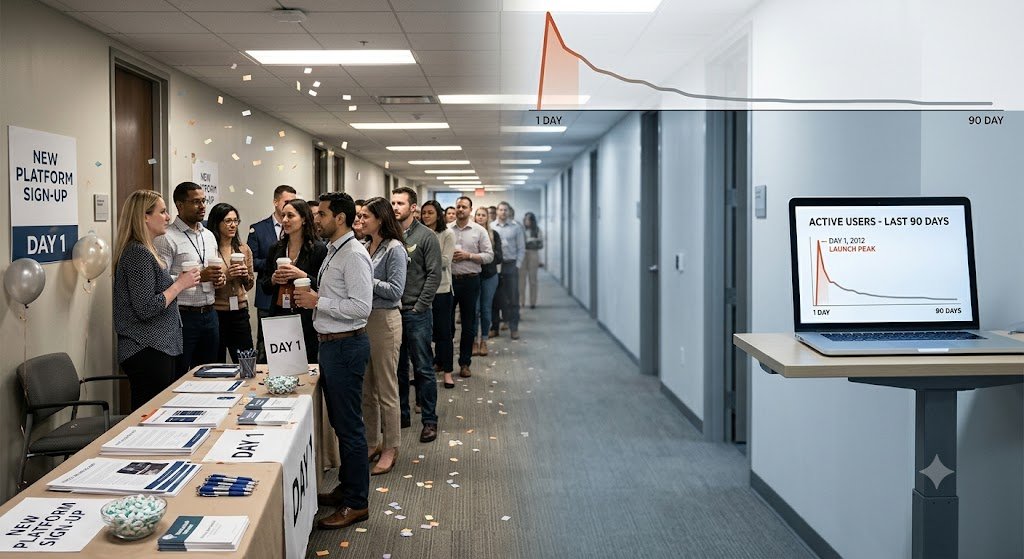
Declaring victory — or failure — based on a single early measurement damages credibility either way. Claim success too early on testimonials alone, and a skeptical executive will eventually ask for real evidence you don’t have. Declare failure too early, before sustained trends have had time to appear, and a program that might have worked gets cancelled before it had a fair chance to show it.
A RAND review of worksite wellness programs (Osilla et al., 2012) found that much of the reported return in this field rests on observational rather than randomized evidence — a caution that applies directly to testimonial-heavy reporting, and a reason to distinguish promising movement from proven causation. A 2026 systematic review and meta-analysis of participatory organizational interventions found no statistically significant pooled effect overall, while noting that the studies that did succeed shared structured evaluation and attention to context — a reminder that uneven results across a body of research, or across your own teams, are normal and worth studying, not an automatic verdict. NIOSH’s Mission Possible guidance reinforces the mechanical discipline underneath all of this: the same measures, applied consistently before and after, are what let you compare trends over time rather than guess at them.
How Does the Anchored Hope Index™ Support Both Pre- and Post-Program Reflection?
The Anchored Hope Index™ gives employees a structured opportunity to reflect on their hope, resilience, and future orientation before and after an initiative. Reviewed in aggregate, it helps HR identify patterns of growth and supports meaningful organizational conversations — it is an educational reflection tool, not a clinical or diagnostic instrument, at either point in the timeline.
Used the same way at each checkpoint, it becomes part of the same-measures discipline this whole approach depends on. “The question isn’t, ‘Did people attend?’ It’s, ‘What changed?’” as Dr. Castillo puts it — and a consistent pre-and-post instrument is one of the few ways to actually answer that question with something more solid than a memory of how the launch felt.
Single-Point Evaluation vs. Phased Evaluation
Table 1. Two Ways to Evaluate the Same Program
| Single-Point Evaluation | Phased Evaluation |
|---|---|
| One survey sent at program completion | Three checkpoints: day 0, 60–90 days, 6–12 months |
| Relies on testimonials and satisfaction scores | Compares behavior and workforce trends to baseline |
| Declares success or failure immediately | Distinguishes immediate learning from sustained change |
| Uneven results treated as proof the program failed | Uneven results treated as data to refine the approach |
| Reports outcomes as caused by the program alone | Reports contribution, acknowledging multiple factors |
Both can use the exact same program as their subject — only one produces evidence that holds up to a hard question later. Framing drawn directly from Dr. Charles Castillo’s Money Dialog answers.
What Should HR Leaders Do First?
- Compare against your original baseline, using the same measures. Consistent measurement, using the exact indicators you started with, is what allows a credible comparison over time — not a new set of questions dreamed up after the fact.
- Evaluate in phases, not all at once. Measure immediate learning at program completion, behavioral application around 60 to 90 days, and sustained organizational trends six to twelve months later. Take the Anchored Hope Index™ at https://anchoredhopeindex.com at each of those three checkpoints as one consistent instrument across all phases.
- Look beyond testimonials to behavior and trend data. Testimonials and satisfaction scores provide valuable color, but they don’t prove lasting change on their own — pair them with objective workforce measures, never replace the measures with them.
- Report contribution, not causation. Present findings with humility: show measurable improvement while recognizing that organizational outcomes are influenced by multiple factors. That honesty is what makes the report credible under scrutiny.
- Treat uneven results as a refinement signal, not a verdict. Study what worked, identify barriers where progress was limited, engage leaders in those areas, and refine the approach. Continuous improvement is a sign of a disciplined organization, not a failed initiative.
Take the Anchored Hope Index™
Six months from now, someone will ask what actually changed — and “people seemed to like it” won’t be a satisfying answer. Take the Anchored Hope Index™ at https://anchoredhopeindex.com as the same instrument at each of your evaluation checkpoints, so that when the question comes, you have a real answer instead of a guess.
Disclaimer
Disclaimer: The Anchored Hope Index™ is an educational and organizational development tool intended to support reflection, awareness, and discussion. It is not a diagnostic, clinical, or mental health assessment instrument and should not be used as a substitute for professional mental health evaluation or treatment.
Frequently Asked Questions
How do we demonstrate improvement after a wellness or resilience program ends?
Compare results to your original baseline using the same measures, evaluated in phases: immediate learning at completion, behavioral application at 60 to 90 days, and sustained trends at six to twelve months. Report contribution honestly rather than claiming the program alone caused every result.
Why aren’t testimonials and satisfaction scores enough to prove a program worked?
They provide valuable stories, and satisfaction reflects the participant’s experience, but neither proves lasting change. They should complement objective measures like behavior and workforce trends, not replace them.
How long should we wait before evaluating results?
Evaluate in phases rather than all at once: immediate learning at program completion, behavioral application around 60 to 90 days, and sustained organizational trends six to twelve months later. Lasting change takes time to show up.
How should post-program findings be compared to the baseline?
Use the same measures you established before the program began. Consistent measurement is what allows you to identify meaningful movement and make credible comparisons over time, rather than comparing different questions asked at different points.
Doesn’t uneven improvement across different teams just prove the program didn’t work?
No — uneven results are an opportunity to learn, not proof of failure. Studying which teams progressed and which didn’t often reveals exactly where to focus next. Take the Anchored Hope Index™ at https://anchoredhopeindex.com at multiple checkpoints to see that variation clearly enough to act on it, not just guess at it.
How does the Anchored Hope Index™ support both pre- and post-program evaluation?
It gives employees a structured opportunity to reflect on hope, resilience, and future orientation before and after an initiative. Reviewed in aggregate, it helps HR identify patterns of growth — it is an educational reflection tool, not a clinical or diagnostic instrument, at either point.
Can we say our program caused the improvement we measured?
Be careful here. Present findings with humility: report measurable improvements while recognizing that organizational outcomes are influenced by multiple factors. Show contribution, not absolute causation.
References
- Osilla et al. — Systematic Review of the Impact of Worksite Wellness Programs, RAND / American Journal of Managed Care, 2012. https://pubmed.ncbi.nlm.nih.gov/22435887/
- NIOSH, CDC — Mission Possible: Measuring Worker Well-Being, June 25, 2021. https://www.cdc.gov/niosh/bulletin/2021/wellbq.html
- NIOSH, CDC — Worker Well-Being Questionnaire (WellBQ), Revised May 2024. https://www.cdc.gov/niosh/docs/2021-110/
- Effects of Participatory Organizational Interventions on Mental Health and Work Performance: A Systematic Review and Meta-Analysis, Journal of Occupational Health, 2026. https://pubmed.ncbi.nlm.nih.gov/42011932/