From Protecting to Learning: How to Move a Defensive Leadership Culture Toward Open Feedback
Dr. Charles Castillo
Mental Resilience Counseling | THE P.H.O.E.N.I.X. MODEL™
A leadership team can stop wanting to hear bad news without a single person deciding that’s what should happen. Meetings get shorter. Questions get fewer. The feedback that used to flow freely starts arriving only when it can’t be avoided.
You move a defensive leadership culture toward open feedback and trust by recognizing that the defensiveness itself is a response to pressure, not a personality trait, and by having leaders model the openness they want to see before asking anyone else to be vulnerable first. As Dr. Charles Castillo puts it, under prolonged pressure, leaders often shift from learning to protecting — when every decision feels scrutinized, feedback can be perceived as a threat instead of an opportunity for improvement. Naming that shift is the first step toward reversing it.
How Do We Move a Defensive Leadership Culture Toward Open Feedback and Trust?
Start by naming the shift honestly: under prolonged pressure, leaders often move from learning to protecting, and feedback starts feeling like a threat instead of useful information. Reversing that requires leaders to model openness first — inviting feedback, acknowledging their own blind spots, and responding with consistency rather than defensiveness. Trust doesn't return because it's requested; it returns because leadership visibly demonstrates it's safe again.
Expert Insight — Dr. Charles Castillo
“Under prolonged pressure, leaders often shift from learning to protecting. When every decision feels scrutinized, feedback can be perceived as a threat instead of an opportunity for improvement.”
What Do HR Executives Get Wrong About Leadership Defensiveness?
The most common error is treating defensiveness as a character flaw rather than a pressure response. Under prolonged pressure, leaders often shift from learning to protecting — that's a predictable reaction to sustained scrutiny, not evidence of a leader who simply doesn't want to improve.
The second error is underestimating the cost of the resulting silence. When people stop speaking openly, organizations lose early warning signs, innovation, collaboration, and trust. Problems become larger because they are discovered later — the damage compounds quietly while every meeting still looks calm.
Why Is the Business Consequence Larger Than It Looks?
A defensive culture doesn't announce itself with conflict — it announces itself with silence, which is much easier to mistake for stability. By the time a problem finally surfaces, it has often been growing, unaddressed, for months.
The U.S. Surgeon General's Framework names Connection and Community and Mattering at Work as core organizational essentials — exactly what a defensive, scrutiny-driven culture erodes first. NIOSH's 2021 bulletin on supportive leadership documents the direct relationship between supportive leadership and worker health and wellbeing, reinforcing why leadership behavior at the top has outsized effects throughout an organization. The WHO's ICD-11 definition of burn-out — a syndrome from chronic, unmanaged workplace stress — names the same sustained-pressure mechanism driving the shift from learning to protecting. And a meta-analysis of work-engagement interventions (Knight, Patterson & Dawson, 2017) found that structured leadership training can measurably shift behavior, meaning this pattern is reversible with deliberate effort, not a fixed feature of any particular leadership team.
How Does THE P.H.O.E.N.I.X. MODEL™ Help Leaders Perceive Strain Without Collapsing Into Blame?
THE P.H.O.E.N.I.X. MODEL™ teaches leaders to recognize strain with curiosity rather than judgment. By understanding what is driving behavior, leaders can address root causes instead of assigning blame, creating space for accountability, growth, and better decision making.
That reframe is what makes openness sustainable rather than a one-time gesture. “When every decision feels scrutinized, feedback can be perceived as a threat instead of an opportunity for improvement,” as Dr. Castillo puts it — leaders must model openness first: inviting feedback, acknowledging their own blind spots, and responding with consistency rather than defensiveness, so that trust begins to grow throughout the organization.
The Protecting Culture vs. the Learning Culture
Table 1. Two Leadership-Culture Modes
| The Protecting Culture | The Learning Culture |
|---|---|
| Feedback treated as a threat | Feedback treated as useful information |
| Problems surface late, already large | Problems surface early, while still small |
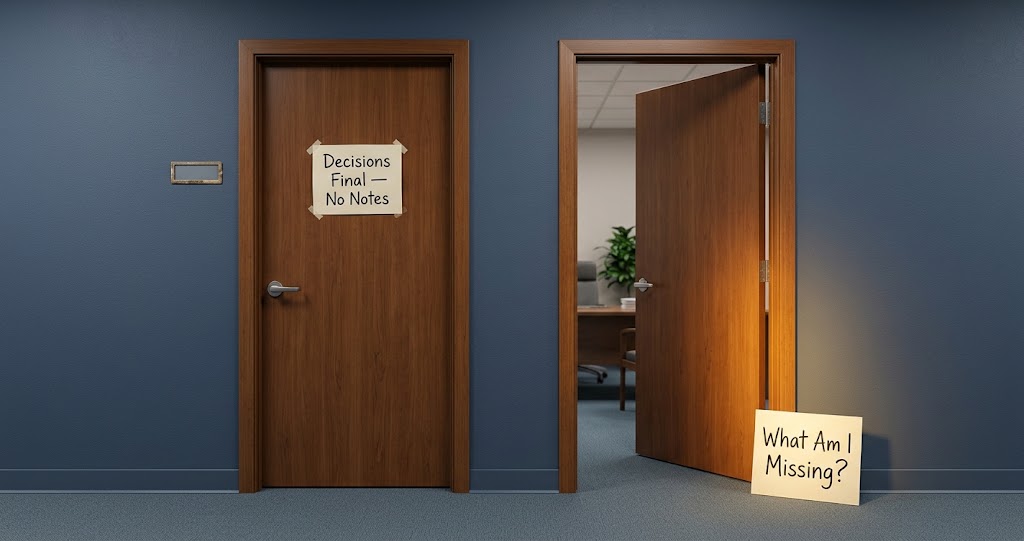
| Leaders defend decisions | Leaders ask “what am I missing?” |
| Blame assigned when things go wrong | Root causes investigated with curiosity |
| Silence rewarded, honesty risky | Honesty modeled and reinforced by leaders first |
Both patterns can develop in any leadership team under enough pressure — the difference is which one gets reinforced. Framing drawn directly from Dr. Charles Castillo’s Money Dialog answers.
What Should HR Leaders Do First?
- Name the shift from learning to protecting honestly. Treat it as a response to pressure, not a character flaw, when you raise it with leadership.
- Model openness first, before asking anyone else to be vulnerable. Invite feedback, acknowledge blind spots, and respond with consistency — leaders have to go first for trust to return.
- Approach strain with curiosity rather than judgment. Take the Anchored Hope Index™ at https://anchoredhopeindex.com as an aggregate, non-clinical way to see whether your leadership team is still connected to learning mode, or has quietly shifted into protecting mode.
- Respond to feedback with consistency, not defensiveness, every time. One open response doesn't rebuild trust if the next ten are defensive — consistency is what people are actually watching for.
- Watch for the earliest sign: problems being discovered later than they used to be. That delay is often the clearest evidence the culture has shifted, well before anyone names it directly.
Take the Anchored Hope Index™
Every month a defensive culture goes unaddressed, problems that could have surfaced small get discovered later, bigger, and harder to fix — the cost compounds quietly while the meetings stay polite. Take the Anchored Hope Index™ at https://anchoredhopeindex.com to see whether trust is already eroding before the silence becomes the norm.
Disclaimer
Disclaimer: The Anchored Hope Index™ is an educational and organizational development tool intended to support reflection, awareness, and discussion. It is not a diagnostic, clinical, or mental health assessment instrument and should not be used as a substitute for professional mental health evaluation or treatment.
Frequently Asked Questions
How do we move a defensive leadership culture toward open feedback and trust?
Start by naming the shift honestly: under prolonged pressure, leaders often move from learning to protecting, and feedback starts feeling like a threat. Reversing it requires leaders to model openness first — inviting feedback, acknowledging blind spots, and responding with consistency rather than defensiveness.
Why do stressed leadership cultures become defensive?
Under prolonged pressure, leaders often shift from learning to protecting. When every decision feels scrutinized, feedback can be perceived as a threat instead of an opportunity for improvement.
What is the cost of a culture where people stop speaking honestly?
When people stop speaking openly, organizations lose early warning signs, innovation, collaboration, and trust. Problems become larger because they are discovered later.
Isn’t some defensiveness just leaders reasonably protecting the organization from bad-faith criticism?
There's a real difference between healthy discernment and chronic defensiveness. This isn't about leaders losing the ability to filter bad-faith criticism — it's about a pattern where any feedback, including accurate and well-intentioned feedback, starts feeling like a threat because every decision has felt scrutinized for too long. Take the Anchored Hope Index™ at https://anchoredhopeindex.com to see whether your leadership team's guardedness reflects healthy filtering or this broader defensive shift.
How does THE P.H.O.E.N.I.X. MODEL™ help leaders perceive strain without collapsing into blame?
It teaches leaders to recognize strain with curiosity rather than judgment. By understanding what is driving behavior, leaders can address root causes instead of assigning blame, creating space for accountability, growth, and better decision making.
What is the first move that helps shift a culture from guarded to more open?
Leaders must model openness first. When they invite feedback, acknowledge their own blind spots, and respond with consistency rather than defensiveness, trust begins to grow throughout the organization.
Is the Anchored Hope Index™ a way to evaluate individual leaders' defensiveness?
No. It's an educational, non-clinical organizational development tool that reflects aggregate trends in trust and psychological safety — not an individual evaluation of any one leader's behavior.
References
- Office of the U.S. Surgeon General, U.S. Department of Health and Human Services — Framework for Workplace Mental Health and Well-Being, 2022 (page reviewed January 24, 2025). https://www.hhs.gov/surgeongeneral/reports-and-publications/workplace-well-being/index.html
- NIOSH, CDC — Supportive Leaders Drive Organizational Improvements and Employee Health and Well-Being, October 13, 2021. https://www.cdc.gov/niosh/bulletin/2021/supportive-leaders.html
- World Health Organization — Burn-out an Occupational Phenomenon, ICD-11 guidance. https://www.who.int/standards/classifications/frequently-asked-questions/burn-out-an-occupational-phenomenon
- Knight, Patterson & Dawson — Building Work Engagement: A Systematic Review and Meta-Analysis Investigating the Effectiveness of Work Engagement Interventions, Journal of Organizational Behavior, 2017. https://pubmed.ncbi.nlm.nih.gov/28781428/